

How Scotland's 2025 alcohol and drug death figures lost their definitions and their years in public statements
Context Matters Consultancy. EiE Intelligence.
Why I keep this watch
Every week I read what is said in public in Scotland about drugs, alcohol and recovery, and I look for one thing: a figure or a term that has travelled further than its context. I do not look at who said it. The same thing happens in government releases, in newspapers, in Parliament, in advocacy and in the professional literature, and it happens on every side of the debate. That is why I keep the watch across the whole sector, and why I publish it as a record rather than a reply to anyone
.
What the watch records, and why it has this name
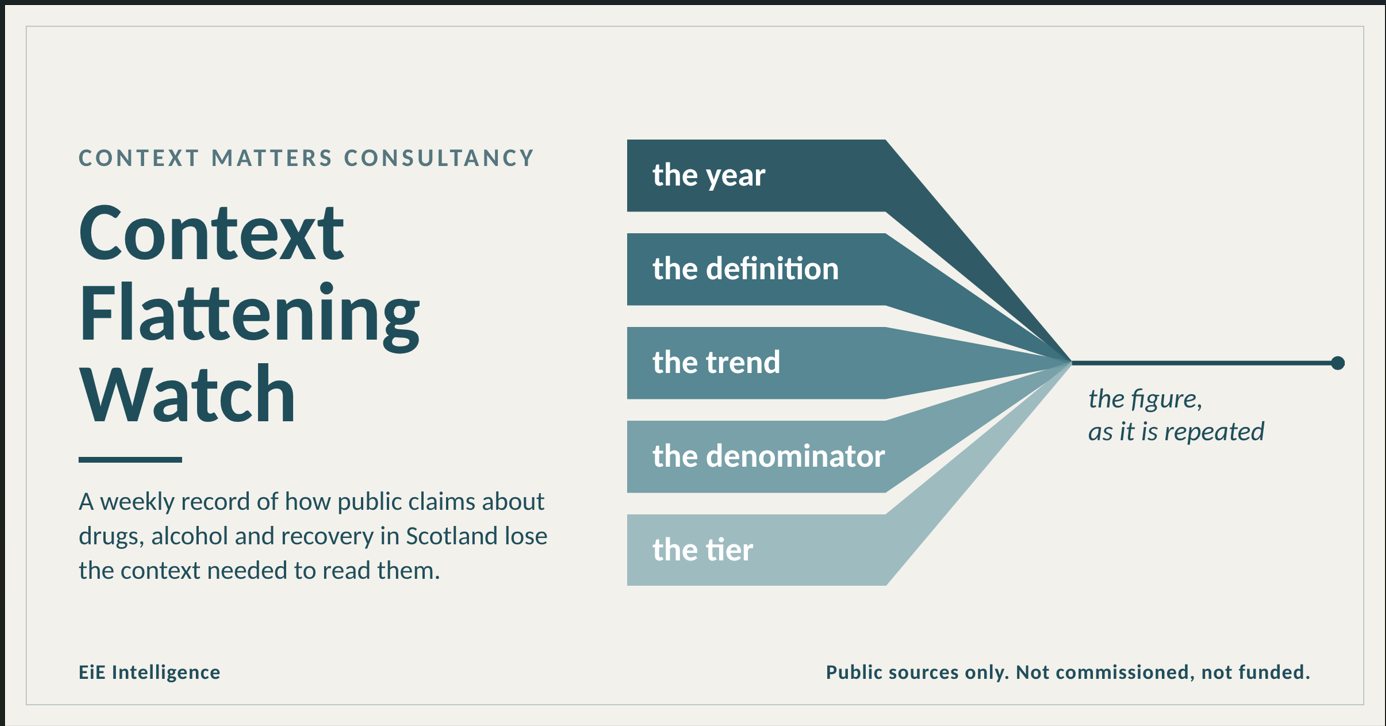
Context flattening is the name Context Matters Consultancy gives to a single, repeated process: a public claim about drugs, alcohol or recovery loses the context a reader needs to understand it. It is called flattening because a figure in public life has depth. It has a year, a definition of what was counted, a trend, a denominator, and a tier of government responsible for the thing it measures. When the figure is pressed into a single line, those layers are pressed out. What is left still looks complete, but it is flat.
It is called a watch because it is a record kept week by week. It records what a text does, not why it was written. The watch makes no judgement about intent, and it identifies its sources only in the references.
Each case is read through the Language Diagnostic, the part of the Context Matters Consultancy model that looks at what words do to the reader's understanding.
In this model it has four categories:
- Substitution: one term is put in the place of another that means something different, and the sentence still reads as if nothing has changed.
- Category Collapse: two or more distinct things, such as two measures, two periods or two tiers of government, are merged and read as one.
- Constitutive Framing: the frame does more than describe; it decides what the thing is taken to be. A count of deaths framed from a political event, for example, becomes a measure of that event.
- Dehumanisation: language that reduces people to a condition, a substance or a statistic.
This week was shaped by two releases on 27/10/2026: the National Records of Scotland figures for alcohol-specific deaths in 2025, and the Public Health Scotland quarterly drug harms report. A debate on preventing alcohol and drug deaths followed in the Scottish Parliament on 29/10/2026. All three cases this week come from text published around those events.
Case 1: a minimum unit pricing estimate, its measure and its years
The text
Published 27/10/2026, alongside the 2025 alcohol-specific deaths figures [1]. Minimum unit pricing, it said,
"had reduced alcohol-attributable deaths by 13.4%"
and, in the same sentence,
"was likely to have reduced hospital admissions wholly attributable to alcohol by 4.1% up to the end of 2020".
What is missing
Two things: the measure and the years. The research behind the 13.4% did not measure "alcohol-attributable" deaths. In alcohol research, that phrase usually takes in conditions that alcohol only partly causes, such as some cancers and heart disease. The research measured deaths wholly attributable to alcohol, a much narrower group. The same sentence uses "wholly attributable" correctly for hospital admissions, so two measures sit side by side under two different labels. The period, "up to the end of 2020", is attached only to the hospital clause, and the whole sentence sits in a release about deaths in 2025.
The record
Research (cited). The evaluation, published in The Lancet in 2023, compared Scotland with England [2]. Over the 32 months after minimum unit pricing began on 01/05/2018, at 50 pence per unit, it estimated a 13.4% reduction in deaths wholly attributable to alcohol. The estimated reduction in hospital admissions, 4.1%, was not statistically significant. The study ended on 31/12/2020. It did not cover the 65 pence price in force since 30/09/2024, and it says nothing about any year after 2020. Like all such evaluations, it estimates what would have happened without the policy; it does not observe it directly.
What the difference does
In this model: the reader takes away a current effect on a broad category of alcohol deaths. The record gives a narrower and older finding, a reduction in deaths wholly caused by alcohol, measured to the end of 2020 at a price that has since changed.
Language Diagnostic: Substitution, because "alcohol-attributable" stands in for "wholly attributable"; and Category Collapse, because an effect estimated for 2018 to 2020 at one price is folded into a statement about 2025 at another.
Confidence: high. The wording, the study's measure and its period were all checked at source.
Case 2: alcohol-specific deaths read as all alcohol deaths
The text
Published 27/10/2026 [3]:
"While the headline figure of the total number of alcohol deaths in Scotland dropping by 3% was positive, the gap between the richest and poorest rose, as did the number of women dying from booze-related illnesses or conditions."
What is missing
The definition. The 3% fall is in alcohol-specific deaths, a deliberately narrow measure. The sentence calls it "the total number of alcohol deaths", then widens the women's figure to an undefined "booze-related illnesses or conditions". The size of that women's figure is missing too: it is a rise of ten deaths.
The record
Research (cited). National Records of Scotland counted 1,152 alcohol-specific deaths registered in 2025, 33 fewer than the 1,185 registered in 2024: a 3% fall, and the lowest figure since 2019 [1][4]. An alcohol-specific death is one whose underlying cause is wholly attributable to alcohol, counted by the year the death was registered. The measure leaves out deaths from conditions that alcohol only partly causes, such as some cancers, strokes and heart conditions, so the full toll of alcohol in Scotland is larger than this figure [5]. The rate in the most deprived areas was 4.8 times the rate in the least deprived [4][6].
What the difference does
In this model: the flattened sentence tells the reader that alcohol deaths in Scotland total 1,152 and fell by 3%. The record says that a narrow group of deaths fell by 3%, while the wider burden of alcohol deaths is not measured by this release at all. A falling headline then stands in for a total it does not contain.
Language Diagnostic: Category Collapse, because a narrow statistical category is presented as the whole; and Substitution, because "booze-related" replaces a defined cause of death with an undefined everyday phrase.
Confidence: high. The wording is verified, and the definition is published and stable.
Case 3: a running total without its first year
The text
Lodged 28/10/2026 [7]:
"regrets that over 7,000 lives have been lost to drugs since the Scottish Government declared a public health emergency"
and, later in the same text,
"with drug-related deaths rising in 2025".
What is missing
The first year. The record holds no single dated declaration to count from. A drug deaths taskforce was set up in 2019 in response to what was described as an emergency; in September 2020, a request for the United Kingdom Government to declare a public health emergency was refused [8]; and the National Mission on drugs began in January 2021. Without a year, the reader cannot rebuild the total. The second phrase also drops the difference between the number of deaths and the rate.
The record
Research (cited). National Records of Scotland counts drug use deaths by year of registration [9]. Added up from three possible starting points:
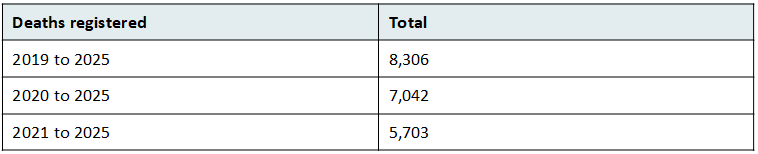
"Over 7,000" holds only if deaths registered in 2020 are counted. On "rising": the number of deaths in 2025 rose by 11%, from 1,017 to 1,133. National Records of Scotland reports the age-standardised rate, 21.4 per 100,000 against 19.1 in 2024, as at a similar level, with the difference not statistically significant [9]. National Records of Scotland now calls this measure "drug use deaths"; "drug-related deaths" is the title of the wider publication.
What the difference does
In this model: a large total with no first year reads as the toll of a period of policy. With the year restored, whether the total passes 7,000 depends almost entirely on whether 2020 is included. And the 2025 rise is a real rise in the number of deaths, but not a statistically significant change in the rate.
Language Diagnostic: Constitutive Framing, because the deaths are counted from a political event rather than a statistical period; and Category Collapse, because the count and the rate are merged under one word.
Confidence: medium. The wording is verified. The rebuilt totals depend on a start date the text does not give.
This week's pattern:
Three texts in one week, and one direction of travel. The evidence for minimum unit pricing was widened to "alcohol-attributable". The alcohol-specific figure was widened to "the total number of alcohol deaths". And a running total of drug deaths lost its first year. In each case the number survived the journey into a public sentence. What it counted, and when, did not.
In this model, this is flattening at its simplest: the figure is accurate, but the context that tells a reader what it measures has gone. None of these figures is wrong in itself. Each becomes a different claim once its definition or its year is removed.
Method and independence
The watch searches public sources only: government and official communication, media coverage of statistics releases, parliamentary text, international comparisons, and professional and academic material, across every side of the debate. Every claim is quoted exactly from its source, with its date, and every figure is checked against the primary statistics. Sources are identified only in the references. This work is not commissioned and not funded.
Any error of fact will be corrected, and the correction noted.
EiE Training’s courses are at eietraining.com.
References
[1] Scottish Government. (2026, October 27). Alcohol-specific deaths [News release]. https://www.gov.scot/news/alcohol-specific-deaths/
[2] Wyper, G. M. A., Mackay, D. F., Fraser, C., Lewsey, J., Robinson, M., Beeston, C., et al. (2023). Evaluating the impact of alcohol minimum unit pricing on deaths and hospitalisations in Scotland: A controlled interrupted time series study. The Lancet, 401(10385), 1361 to 1370. https://doi.org/10.1016/S0140-6736(23)00497-X
[3] Scottish Daily Express. (2026, October 27). John Swinney's day of shame as trio of scandals engulf his leadership. https://www.scottishdailyexpress.co.uk/news/politics/john-swinneys-day-shame-trio-37814598
[4] Scottish Drugs Forum. (2026, October 27). National Records of Scotland report on alcohol-specific deaths. https://sdf.org.uk/national-records-of-scotland-report-on-alcohol-specific-deaths/
[5] Alcohol Focus Scotland. (2026, October 27). Urgent measures needed from Scottish Government to prevent further deaths from alcohol say leading organisations. https://www.alcohol-focus-scotland.org.uk/news/news/urgent-measures-needed-from-scottish-government-to-prevent-further-deaths-from-alcohol-say/
[6] STV News. (2026, October 27). Fewer people dying from alcohol in Scotland but gap between richest and poorest grows. https://news.stv.tv/scotland/fewer-people-dying-from-alcohol-in-scotland-but-gap-between-richest-and-poorest-grows
[7] Scottish Parliament. (2026, October 28). S7M-01766.2: Amendment to motion S7M-01766, Strengthening Scotland's public health approach to preventing alcohol and drug deaths. https://www.parliament.scot/chamber-and-committees/votes-and-motions/S7M-01766-2
[8] STV News. (2020, September 7). Drug deaths crisis 'not a public health emergency'. https://news.stv.tv/scotland/drug-deaths-soar-but-public-health-emergency-rejected
[9] National Records of Scotland. (2026, September 23). Drug-related deaths in Scotland, 2025. https://www.nrscotland.gov.uk/publications/drug-related-deaths-in-scotland-2025/
About the author
Jim Storrar is the founder of Context Matters Consultancy and EiE Training. His nursing career began in 1987 and included twenty-six years in the National Health Service in Scotland, across psychiatric, addiction, forensic and public health settings. As Education and Prevention Specialist at National Health Service Ayrshire and Arran from 2009 to 2013, he was part of the team delivering the board’s Blood Borne Virus work. He developed the Learn-Pro Hepatitis C learning module, ran the peer education pilots and delivered Alcohol Brief Interventions training. He then lectured in health and social care at West Lothian College from 2013 to 2019.
He holds a Bachelor of Science in Health Studies, a Diploma in Higher Education in Mental Health Nursing, a Postgraduate Diploma in Alcohol and Drug Studies and a Teaching Qualification in Further Education. He is a member of the International Society of Substance Use Professionals and the Association of Health Care Trainers.
Comments ()