

Context Check: how to tell a genuine evidence-based argument from one that only looks like one
Standpoint
For most of my working life, part of the job was checking what a claim actually rested on. In nursing, in service design and in teaching, the habit was the same: before acting on an argument, read the source it came from and see whether it says what it is being used to say.
Over the years I have learned that the language of evidence is easy to pick up. Anyone can write that a finding is limited, list a set of references and describe a mechanism. The discipline underneath that language is harder. It means letting the evidence change your mind, and saying so when it does.
This piece sets out how to tell the two apart. It is written for anyone who reads arguments about drugs, alcohol, health or social care and wants to judge them for themselves.
Method and independence
This piece draws only on published sources. It was not commissioned or funded by anyone. It examines a pattern of argument, not any individual argument, and every illustration in it was written for the piece.
Where this sits
Context Matters Consultancy reads claims against their sources. The Context Flattening Watch records, week by week, where context is lost between a source and the way it is used. The Seven Signals describe the mechanisms by which harm grows in people and services (Context Matters Consultancy, 2026).
Context Check is the name of a new standing series that turns that lens round and hands it to the reader. It is called a check because it is something you do, not something you are told. Each part sets out tests that anyone can apply to an argument, without needing to trust us or anyone else.
Why it has this name
Forensic in Form is the name given here to an argument that has the form of forensic analysis without its function.
The form is the visible part:
stated limits, caveated sources, the language of mechanism, an acknowledgement of one's own position.
The function is what that form exists to do, which is to let the evidence decide the conclusion. "Forensic" is used because forensic work is the testing of a claim against a record. "In form" is used because, in these arguments, the shape of that testing is present and the testing itself is not.
In this model, the distinction matters more as the language of evidence spreads. When few people stated limits or listed sources, their presence was a fair sign of care. Now that the markers are widely used, they can no longer stand in for the work. A reader needs a way to look beneath them.
The core distinction
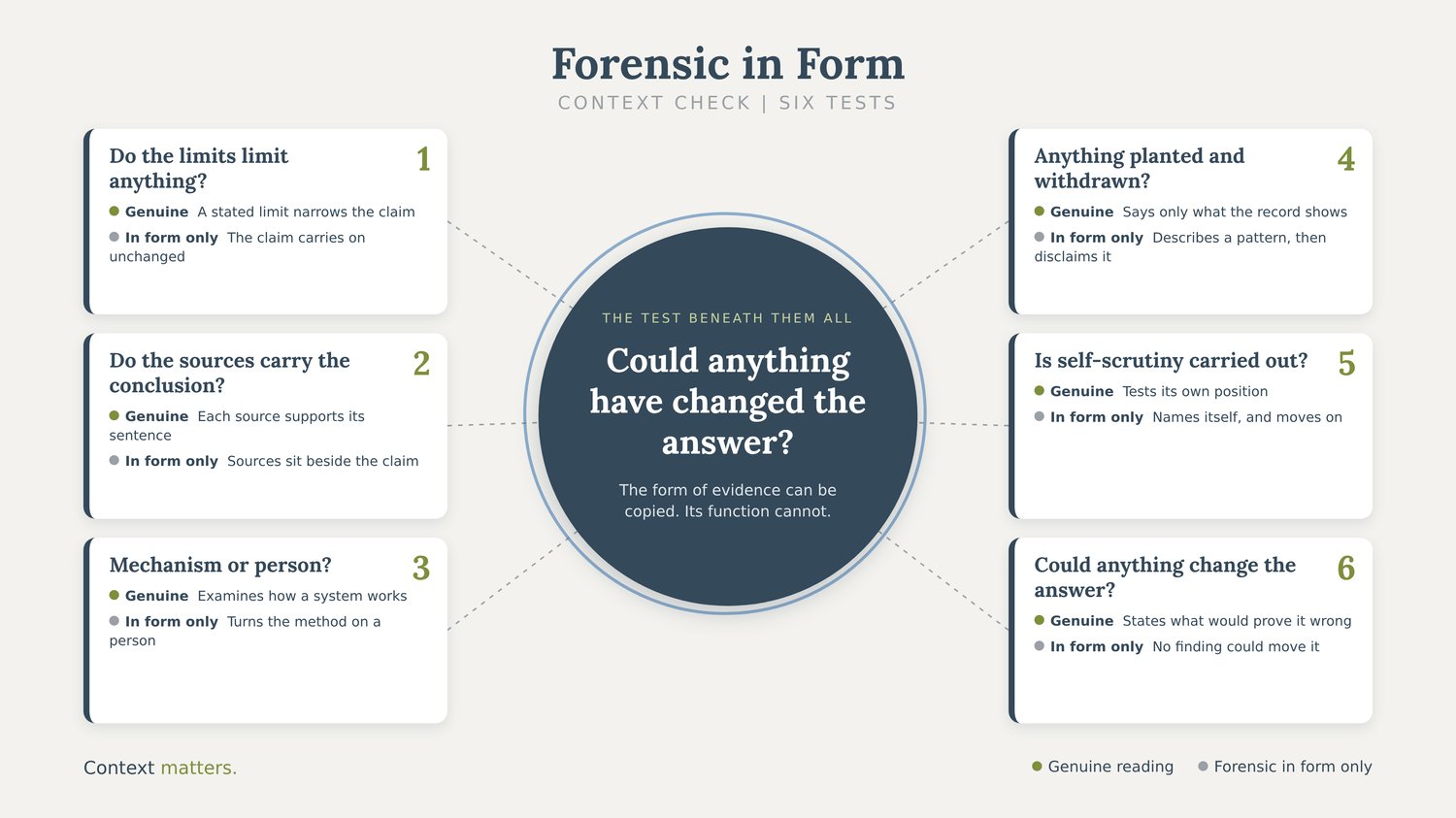
A forensic reading is defined by what it does, not by how it sounds. Its markers can be copied. What cannot be copied is whether the method was allowed to change the answer.
In this model, that is the single test beneath all the others. The six movements below each ask it from a different angle, each paired with a thinker whose work explains why the imitation works on readers.
Movement One: The limit that limits nothing
Theorist: Pierre Bourdieu, on scientific authority as a form of capital
A stated limit is a promise to the reader: this is as far as the evidence goes. In a genuine reading, the claim that follows is smaller because of it. If a report notes that its data cannot show cause, its recommendations are framed as possibilities, not consequences.
In an argument that is forensic in form, the limit is stated and then nothing changes. A sentence admits that the evidence cannot show something, and the next sentence concludes as if it does. The limit has been used as a credential, not as a boundary.
Bourdieu (1975) described scientific authority as a kind of capital: a recognised standing that gives a speaker's words weight in their field. The markers of careful method are part of how that capital is displayed. They signal that the speaker belongs among those whose claims are to be taken seriously. In this model, a limit that limits nothing is capital spent without the method that earns it.
It borrows the standing of caution while keeping the freedom of assertion.
Movement Two: The source beside the claim
Theorist: Bruno Latour, on citations as allies
A reference list shows what was consulted. It does not show what was found. In a genuine reading, each source supports the specific claim it is placed under, and where a source carries its own caveats, they are carried into the argument and allowed to shape it.
In an argument that is forensic in form, sources sit beside a claim rather than under it. A review whose own summary says the evidence is too thin to judge is listed in support of a firm conclusion. Sometimes the caveat is even quoted, and the conclusion is left standing regardless.
Latour (1987) showed how citations work as allies: a claim surrounded by references becomes harder to challenge, because a doubter must now take on every source as well as the claim. The strength comes from the number and standing of the allies, not from whether each one actually agrees. In this model, a source beside the claim is an ally recruited for its presence. The test is simple:
read the source, and ask whether its author would sign the sentence it is attached to.
Movement Three: The person in place of the mechanism
Theorist: C. Wright Mills, on personal troubles and public issues
Forensic work examines how a system produces an outcome: the rules, the incentives, the funding routes and the way information moves. People appear in it as parts of the mechanism, not as its subject.
In an argument that is forensic in form, the method is turned on a named individual or organisation. An analysis of prescribing rates becomes an analysis of one leader's character. The vocabulary of systems stays, but the subject has become personal, and a personal subject cannot be tested in the same way. Character can be asserted; it cannot be checked against a record.
Mills (1959) separated personal troubles, which belong to an individual and their immediate world, from public issues, which belong to the structure of a society. Understanding comes from seeing how the one is shaped by the other. In this model, an argument that is forensic in form runs the process backwards: it takes a public issue and turns it into a personal trouble attached to someone it can name.
The structure disappears from view, which is the opposite of what forensic analysis is for.
Movement Four: The suggestion planted and withdrawn
Theorist: H. P. Grice, on implicature
A genuine reading says what the record shows and stops there. Where a connection cannot be shown, it is not described, because describing it in detail is itself a way of asserting it.
In an argument that is forensic in form, a pattern is set out at length and then disclaimed. A report might describe how two suppliers raised their prices in the same weeks, over several years, and then add that coordination cannot be shown. The disclaimer is accurate. The description has already done its work.
Grice (1975) explained how people communicate more than they literally say. A listener assumes that what is said is relevant, so detail offered at length is taken to mean something, even when the words stop short of stating it. That unstated meaning is implicature, and because it is never stated, it can always be denied. In this model, this is Deniable Attribution Architecture, one of the Seven Signals, working at the scale of a single argument:
the reader keeps the suggestion, and the writer keeps the deniability (Context Matters Consultancy, 2026).
Movement Five: Scrutiny named, not carried out
Theorist: Erving Goffman, on the presentation of self
Self-scrutiny is a method, not a phrase. In a genuine reading, the same tests applied to others are applied to the writer's own position, and the result is reported, including where the writer's own case turns out weaker than it looked.
In an argument that is forensic in form, the writer or organisation names itself in a list of those who ought to be examined, and the examination never follows. The naming does the work of humility without the cost of it.
Goffman (1959) described social life as performance: people present a front to their audience, managing the impression they give while keeping a back region out of view. In this model, scrutiny named but not carried out is front-stage humility. It shows the audience a self that is open to examination, while the back region,the writer's own evidence, incentives and position, stays where the audience cannot see it.
the writer's own evidence, incentives and position, stays where the audience cannot see it.
Movement Six: The answer that could not change
Theorist: Karl Popper, on falsifiability
A genuine reading says, at least implicitly, what evidence would prove it wrong, and it would change its conclusion if that evidence appeared.
In an argument that is forensic in form, the conclusion was in place before the evidence was gathered, and every finding is read as confirming it. A rise confirms it; a fall is discounted. A supportive study is evidence; a critical one shows the field's bias. Whatever the record says, the answer stays the same.
Popper (1959) argued that a claim no possible observation could contradict is not being tested at all. The strength of a theory lies in the risks it takes: the outcomes it forbids. In this model, an answer that could not change is the clearest sign that a method was decoration. The other five movements describe how the decoration is built. This one shows that, underneath it, nothing was ever at risk.
In this model, an answer that could not change is the clearest sign that a method was decoration.
Synthesis: the six tests
Set side by side, the six movements give a reader six questions. Each can be asked of any argument in a few minutes, with the argument and its sources open in front of them.
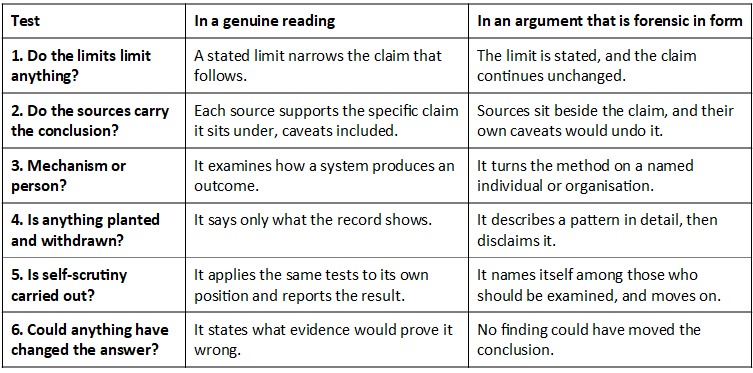
In this model, the six are not independent. An argument that fails the sixth will usually show at least one of the others, because a conclusion that cannot move needs something to hold it in place: a limit that does not bind, an ally that does not agree, a person in place of a mechanism, a suggestion that cannot be checked, or humility that is only shown.
It happens on every side
Arguments that are forensic in form are not owned by any camp. Advocates of every approach to drugs and alcohol, including harm reduction, treatment providers, recovery organisations and governments, can borrow the appearance of evidence when it suits them, and every one of them has done so at some time. The tests apply equally to all of them.
They apply to Context Matters Consultancy too. Readers are invited to use them on our work, and to tell us where we fall short.
What a genuine reading looks like
- The claim is laid out in full before it is tested.
- Limits are stated where they bite, and the conclusion shrinks to fit them.
- Sources are read, not listed, and their caveats travel with them.
- The subject is the mechanism, not the people inside it.
- What cannot be shown is left unsaid, not described and then disclaimed.
- The writer's own position is tested, and the result reported.
- It says what would prove it wrong.
What this piece does not show
The six tests are a reading aid, not a verdict. Passing them does not make an argument right, and failing one does not make it wrong. They show whether the method was used, not whether the conclusion is true. An argument can be forensic in form and still reach a sound conclusion by another route; it simply has not shown that it did.
Nor do the tests show intent. A writer may fail them through haste, habit or the conventions of their field, without any wish to mislead. In these models, a mechanism can operate without anyone choosing it.
What would show this reading to be wrong
If arguments that fail these tests turned out, over time, to be as reliable as those that pass them, the tests would be measuring style rather than substance, and this piece would be wrong. That is a question readers can check for themselves, across any set of arguments they follow.
Conclusion
The words of evidence are now widely spoken. That is welcome: more people asking for sources and stating limits is good for public debate. But the words are not the work. The work is letting the record decide, and accepting its answer when it is not the one you wanted.
Context is in the evidence. The question to bring to any careful-sounding argument is the one beneath all six tests: could anything have changed the answer?
Any error of fact will be corrected, and the correction noted.
EiE Training's courses are at eietraining.com.
References
Bourdieu, P. (1975). The specificity of the scientific field and the social conditions of the progress of reason. Social Science Information, 14(6), 19-47.
Context Matters Consultancy. (2026). Maps, not mandates [LinkedIn article]. https://www.linkedin.com/pulse/maps-mandates-jim-storrar-bsc-pg-dip-tqfe-dip-he-nursing-ejxqe
Goffman, E. (1959). The presentation of self in everyday life. Doubleday.
Grice, H. P. (1975). Logic and conversation. In P. Cole & J. L. Morgan (Editors), Syntax and semantics: Volume 3. Speech acts (pages 41-58). Academic Press.
Latour, B. (1987). Science in action: How to follow scientists and engineers through society. Harvard University Press.
Mills, C. W. (1959). The sociological imagination. Oxford University Press.
Popper, K. (1959). The logic of scientific discovery. Hutchinson.
About the author
Jim Storrar is the founder of Context Matters Consultancy and EiE Training, and a specialist in addiction, mental health and recovery. He began nursing in May 1987 and worked for twenty-six years in the National Health Service in Scotland, across psychiatric, addiction, forensic and public health settings. Between 2009 and 2013 he was Education and Prevention Specialist with NHS Ayrshire and Arran, where he was part of the team for Blood Borne Virus work under the national Hepatitis C target, developed the LearnPro Hepatitis C learning module, ran its peer education pilots, and delivered Alcohol Brief Interventions training. He later lectured in health and social care at West Lothian College. He holds a Bachelor of Science in Health Studies, a Diploma in Higher Education in Mental Health Nursing, a Postgraduate Diploma in Alcohol and Drug Studies and a Teaching Qualification in Further Education. He is a Specialist Member of the International Society of Substance Use Professionals and a member of the Association of Health Care Trainers.
Comments ()