

Overdose prevention site closure in Alberta, the Jellinek survey, and who addiction evidence cannot see
Standpoint
For almost forty years I have watched people stay away from services that would ask them to be known first. Some feared the police. Some feared losing their children. Some feared an employer finding out, or simply being seen. Their risks were real, and they rarely appear in the figures later used to decide which services should exist. This piece is about why that happens, and why it keeps happening. Jim Storrar
Why this piece, and why now
A peer-reviewed study of the closure of an overdose prevention site in Alberta, Canada, published in March 2026, has begun to circulate in United Kingdom discussion of drug policy, where it is presented as evidence that such sites may not help. This piece does not examine who is sharing it. It examines what the study could and could not see, and why that limit has a long history in addiction research.
What the study did
The study followed people who had used an overdose prevention site in Red Deer, Alberta, which closed on 31/03/2025, and compared them with people who used a similar site in Lethbridge that stayed open. It included 381 people from Red Deer and 300 from Lethbridge, and followed them for 26 weeks after the closure (Day and colleagues, 2026).
Among former site users, it found a rise in opioid agonist treatment, and no significant change in emergency department visits or ambulance responses to suspected opioid events. There were five deaths in the 26 weeks after the closure and six in the 26 weeks before, too few to analyse statistically. It did find a significant rise in hospital admissions after the closure, steeper than in Lethbridge (Day and colleagues, 2026).
The authors are clear about what their results can bear. They write that the findings “should be interpreted as inconclusive rather than evidence of no effect” (Day and colleagues, 2026).
What the study could not see
Three limits matter. Each is drawn from the published record, not from opinion.
First, size. The study could only have detected large differences. The authors estimate that a difference in ambulance overdose responses would have needed to be around 96 per cent to be detected (Day and colleagues, 2026). When a study of this size does not find an effect, that is not evidence that no effect exists, which is the authors’ own point.
Second, other changes happening at the same time. A mobile addictions clinic and an overdose response team were introduced around the former Red Deer site, and not in Lethbridge (CATIE, 2026). The drug supply also differed: carfentanil was present in 36 per cent of Red Deer's 2025 drug toxicity deaths, against 6 per cent in Lethbridge (CATIE, 2026), and the authors themselves note it was substantially higher in Red Deer during the study (Day and colleagues, 2026). The record does not show which of these changes, if any, produced the outcomes measured.
Third, and most important, the room itself. Since 2022, Alberta's rules for supervised consumption services have required staff to ask people for their personal health number. The provincial government said nobody should be turned away for refusing. When the requirement was challenged in court, the judge declined to halt it, while accepting that “irreparable harm will occur to some illicit drug users” (CBC News, 2022).
At the two sites in this study, a number was recorded for more than 94 per cent of users, and the 3 to 6 per cent without one could not be included (Day and colleagues, 2026). That small figure is not the point. The point is who never appears at all: anyone who stopped using a site, or never came, because they were asked to be identified. The study cannot see them, because the rule that produced its data is the same rule that may have kept them away.
Why we call it the counted room
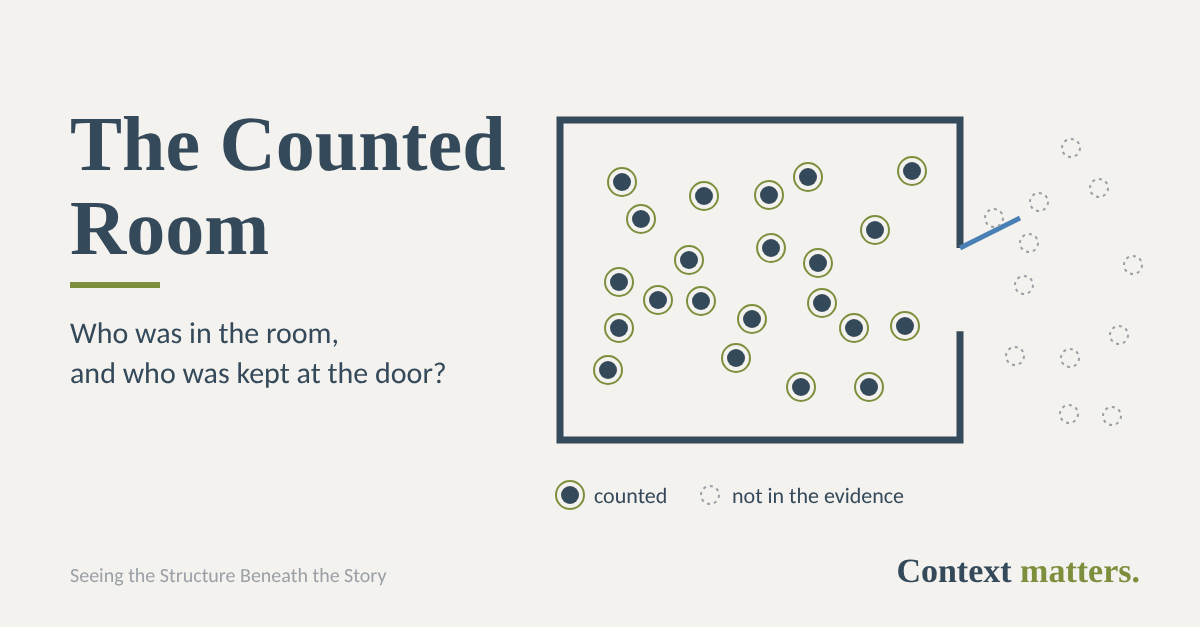
This piece gives that third limit a name, because the same mechanism appears across very different research, and a name makes it easier to recognise when it appears again. In this model, the counted room works like this. Evidence can only describe the people inside the room it counts. The door to that room is a condition of entry: membership, identification or diagnosis. Conclusions drawn from the people inside are then applied to everyone, including the people the door kept out. The name describes exactly that: a room where everyone present was counted, and nobody outside it was.
The same room, eighty years earlier
In 1946, E. M. Jellinek published an analysis of a questionnaire that had been printed on the front page of the Grapevine, the official publication of Alcoholics Anonymous, in May 1945 (Jellinek, 1946). Of the 158 members who returned it, 98 questionnaires were analysed. Some were excluded because they were incomplete or reported only group averages. Fifteen from women were set aside because, in Jellinek's words, “the data differed so greatly for the two sexes that merging the data was inadvisable” (Jellinek, 1946).
Jellinek was clear about what this meant: “Interpretation of the data must be limited, therefore, to alcoholics of the same types” (Jellinek, 1946). The phases of drinking he described later became a widely reproduced chart of progression, and that chart travelled far beyond the limit he set (Roizen, 2011).
The door then was membership of Alcoholics Anonymous. The door in Alberta is a personal health number. The questions were different, and the room was the same.
Who stands outside the door
In practice, people who avoid identification usually have reasons: fear of criminalisation, fear of child protection involvement, fear of an employer finding out, and fear of stigma. This is a practice observation, drawn from four decades of work across addiction, mental health and forensic settings. It is not a finding of either study, and neither study can tell us why the people outside the room stayed there.
What this means in the United Kingdom
Some evidence in Scotland is built differently. The Needle Exchange Surveillance Initiative recruits people at needle exchange services, on a voluntary and confidential basis, and tests blood spot samples anonymously, linking each to its questionnaire only through an assigned study number (Public Health Scotland, 2024). Evidence built this way can reach people that a counted room cannot.
In this model, the risk is that evidence from a counted room abroad is used to judge services designed for the people outside it. The same mechanism would apply to any route into care that begins with a condition of entry. A statutory right to treatment that begins with a diagnosis would, in this model, count only the people who accept the diagnosis. That is a description of how such a design measures, not a judgement of anyone's intentions.
The test applies equally in every direction. Evidence used to support harm reduction services has its own doors and its own rooms, and deserves the same question.
The question to ask of any figure
Who was in the room, and who was kept at the door?
Method and independence
This piece draws only on public sources. It was not commissioned and is not funded. Context Matters Consultancy monitors how evidence, from the United Kingdom and from other countries, enters United Kingdom discussion of drug and alcohol policy, whichever position that evidence is used to support. Any error of fact will be corrected, and the correction noted.
References
CATIE. (2026). Findings of an Alberta study on overdose prevention site closure in context. https://www.catie.ca/catie-news/findings-of-an-alberta-study-on-overdose-prevention-site-closure-in-context
CBC News. (2022, January). Alberta court says supervised consumption sites can ask for health ID numbers. https://www.cbc.ca/news/canada/edmonton/alberta-court-says-supervised-consumption-sites-can-ask-for-health-id-numbers-1.6311502
Day, N., Kaufmann, K., Devoe, D. J. A., Grubac, V., DiMarzo, A., Osmanli, H., Norton, V., Vik, S., Mathew, N., Tanguay, R. L., and Bahji, A. (2026). Healthcare utilization and mortality after overdose prevention site closure: A linked cohort analysis using segmented difference-in-differences time series. Addiction, 1-8. https://doi.org/10.1111/add.70380
Jellinek, E. M. (1946). Phases in the drinking history of alcoholics: Analysis of a survey conducted by the official organ of Alcoholics Anonymous. Quarterly Journal of Studies on Alcohol, 7, 1-88. https://doi.org/10.15288/qjsa.1946.7.1
Public Health Scotland. (2024, August 13). Needle Exchange Surveillance Initiative: Monitoring blood-borne viruses and injecting risk behaviours among people who inject drugs in Scotland, 2008-09 to 2022-23. https://www.drugsandalcohol.ie/41738/1/nesi-2022-23-report.pdf
Roizen, R. (2011, May 28). What time do you want it to be? Finessing science, part two. Points. https://pointshistory.org/post/what-time-do-you-want-it-to-be-finessing-science-part-two
Comments ()