

What is the moral model of addiction? Its history, its logic, and why it still shapes how we respond to drinking and drug use
Watch the video: CMC Explains, The Moral Model
Standpoint
When people talk about addiction, they are usually using a model without knowing it. The oldest of these is the moral model. If you look at a newspaper article about addiction, or the comments on addiction related statistics, it is there. I see it every week, in a raised eyebrow, in “he just needs to want it enough”, in a policy that treats stopping as the only proof of change. I made the CMC Explains series so that each model can be seen for what it is: a way of explaining, with a history, rather than simply the truth. This article goes with the first episode. Jim Storrar
What the moral model says
The moral model explains drinking and drug use as a failure of character. A person drinks too much because they are weak, careless or sinful, and they stop when they find the strength, the faith or the discipline to choose otherwise. The cause sits inside the person, in their will, and so does the cure.
It is called a model because it is a way of explaining why something happens and what should be done about it, not a description of a single fact. It is called moral because it places both the problem and the solution in a person’s choices and character. The people who held this view for most of history did not call it a model at all. The name came later, from researchers comparing it with other ways of helping. Brickman and colleagues (1982) described a moral model as one in which people are held responsible both for causing their problems and for solving them. That is the sense used here.
The oldest picture: Noah
One of the oldest written accounts of drunkenness is in the Book of Genesis. After the flood, Noah plants a vineyard, drinks the wine, and lies uncovered in his tent, and the story turns on the shame that follows (Genesis, chapter 9, verses 20 to 27). Around 1509, Michelangelo painted the scene on the ceiling of the Sistine Chapel in Rome as The Drunkenness of Noah.
The point for this explainer is not the theology. It is that, from very early on, drinking too much was told as a story about conduct and shame. The drinker is the subject of the story, and the lesson is about the person, not the drink.
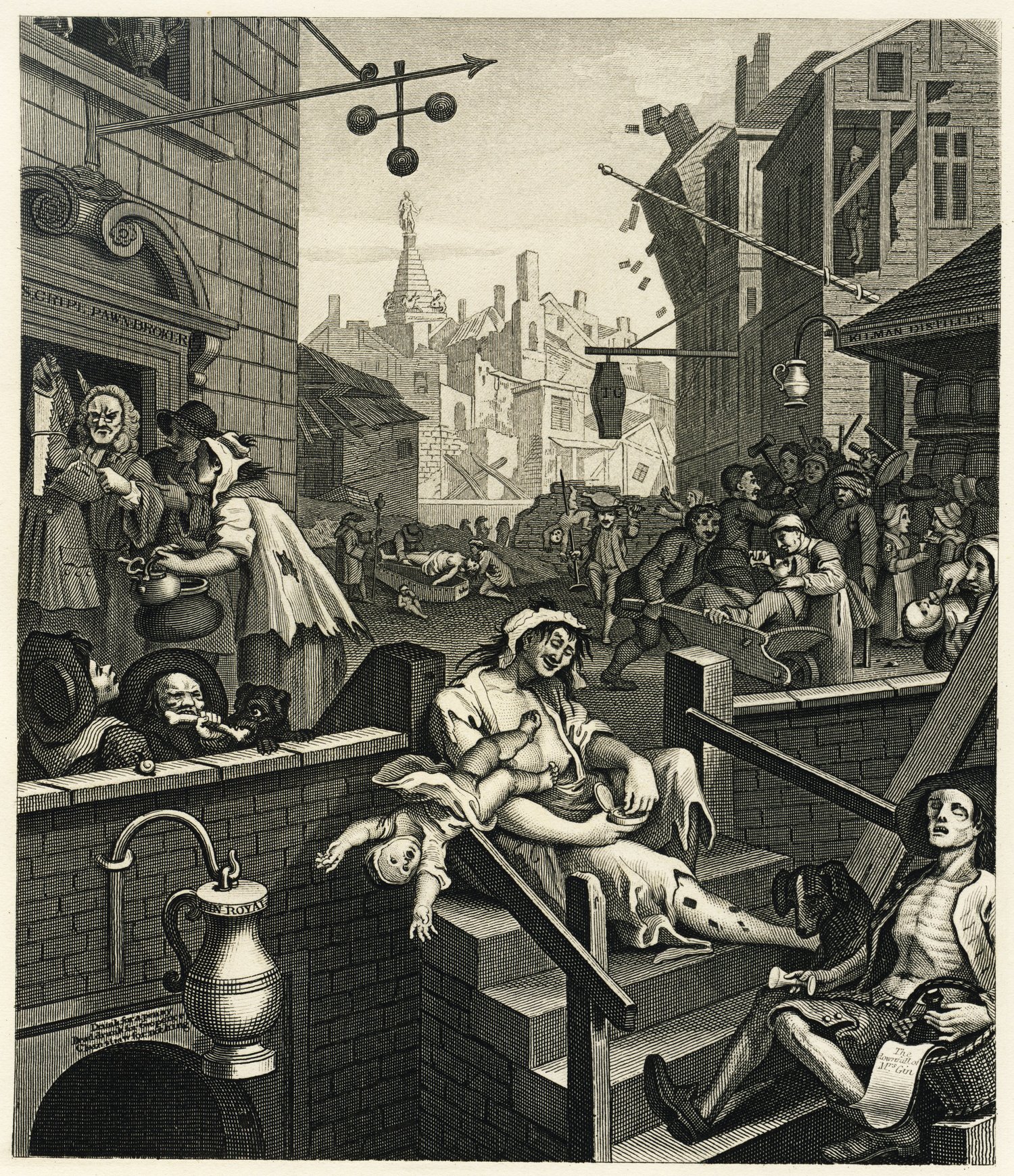
Gin Lane: drink as the ruin of a city
In the first half of the eighteenth century, cheap gin spread rapidly through London, a period often called the gin craze. Gin gained the nickname “mother’s ruin”. In February 1751, William Hogarth issued two prints, Beer Street and Gin Lane. Beer Street shows a healthy, working, prosperous street. Gin Lane shows collapse: a mother too drunk to notice her child falling, a pawnbroker thriving, buildings falling down. The same year, Parliament passed the Gin Act of 1751, which reduced the number of gin shops (Royal Academy of Arts, n.d.).
Gin Lane shows the moral model at the scale of a whole city. Drink is pictured as the cause of poverty, neglect and death, and the remedy is to change behaviour and restrict supply. It is worth noticing what a picture like this leaves out. Poverty, overcrowding and work appear as results of gin, not as reasons people drank it. That is a feature of the model, not a mistake by one artist: a model that places the cause in the person will tend to show conditions as consequences.
Related reading: how societies have tried to remove the drink itself, in Alcohol Prohibition Worldwide: Temperance, Crime and the Disease Model.
The temperance paradox: physicians who spoke of disease
The nineteenth century saw the rise of the temperance movement, in Britain, America and across northern Europe. It is usually remembered as moral and religious. What is less often remembered is that some of its earliest and most influential voices were physicians, and that they used the language of disease.
In America, the physician Benjamin Rush published An Inquiry into the Effects of Spirituous Liquors on the Human Body in 1784. Rush described habitual drunkenness as a disease, a disease of the will (Levine, 1978). He also wrote that “the use of strong drink is at first the effect of free agency” (Rush, as quoted in Levine, 1978). In other words, the drinker chose at first, and lost the choice over time.
In Britain, the Scottish naval physician Thomas Trotter wrote his Edinburgh doctoral thesis on drunkenness in 1788, and expanded it into an essay published in 1804. He wrote: “I consider drunkenness, strictly speaking, to be a disease” (Trotter, 1813).
In Sweden, the physician Magnus Huss published Alcoholismus Chronicus from 1849, and gave the world the word alcoholism. Its Swedish subtitle describes chronic alcohol disease (Huss, 1849).
This is the paradox. The idea of addiction as a disease was already present inside the moral era, voiced by doctors.
Yet the response it led to stayed moral. Levine (1978) puts it plainly: “the temperance movement found the source of addiction in the drug itself”. If the drink was the danger, and the will was what failed, the answer was to remove the drink and strengthen the will.
The treatment logic: total abstinence, enforced
Rush prescribed total abstinence from spirits as the only cure for the drunkard (Levine, 1978). Across the nineteenth century, temperance moved from moderation to the pledge of total abstinence, and then, in several countries, towards law. The best known end point is national prohibition in the United States, from 1920 to 1933.
In this model, the logic runs in a straight line. If the cause is weakness of will, the treatment is to restore moral strength. If the substance overpowers the will, the substance must go completely. And if individuals cannot be relied on to keep away from it, the community and the law should keep it away from them. Abstinence is not one option among several. It is the proof that the person has been corrected.
Related reading: how communities enforce these expectations on each other, in Societal Enforcement, Economic Interests, and the Path Toward Compassionate Recovery.
Stigma: how the moral model works on people
A model is not only an explanation. It also changes how people are seen and treated. The main way the moral model does this is through stigma.
The word stigma comes from the Greek for a mark or brand. The sociologist Erving Goffman used it in 1963 to describe how a single attribute can come to stand for a whole person, so that they are seen as discredited rather than as someone with a difficulty. One of the forms he described could have been written about the moral model itself: “blemishes of individual character perceived as weak will”, which he said are “inferred from a known record of, for example, mental disorder, imprisonment, addiction, alcoholism” (Goffman, 1963, p. 4).
In this model, stigma is not a side effect. It is part of how the moral model works. If drinking or drug use is a failure of character, then the person, not the substance or their circumstances, becomes the problem. Shame then does the work the model expects: it is meant to push the person towards changing. What it also does, in practice, is push people away from being seen. People hide their use, delay asking for help, and keep away from services that would require them to be known first. This last point is practice observation, drawn from Jim Storrar’s work in health and recovery services.
Related reading: how the meaning of addiction is shaped by the society around it, in The Social Construction of Addiction: Unravelling Societal Influences and Cultural Narratives.
The bridge: Jellinek and the higher power
The moral model did not end when the language of disease arrived. It travelled into the twentieth century, and one of the routes it took was through the fellowship that shaped the modern disease idea.
Alcoholics Anonymous began in 1935 in Akron, Ohio, after a meeting between its two founders, Bill W. and Dr. Bob S. Both had earlier contact with the Oxford Group, which Alcoholics Anonymous describes as a “mostly nonalcoholic fellowship” that “emphasized universal spiritual values in daily living”. The fellowship published its basic text, Alcoholics Anonymous, in early 1939 (Alcoholics Anonymous World Services, n.d.-a).
Its Twelve Steps begin by placing the problem beyond the will: “We admitted we were powerless over alcohol”. They then place the solution with a higher power: “Came to believe that a Power greater than ourselves could restore us to sanity”, and “Were entirely ready to have God remove all these defects of character” (Alcoholics Anonymous World Services, n.d.-b).
This is why the higher power matters to the story of the models. The cause has moved away from the will, which is a real break from the moral model. The repair, though, is still described in the language of character and the spirit. For many people this has been the route to recovery, and this explainer makes no judgement on that. Its point is about the model: moral language did not disappear, it was carried forward.
It was carried into science too. In 1946, E. M. Jellinek published his analysis of a questionnaire printed in the Grapevine, the official publication of Alcoholics Anonymous. Of the 158 members who returned it, 98 questionnaires were analysed (Jellinek, 1946). In 1960 he published The Disease Concept of Alcoholism (Jellinek, 1960), which became one of the foundations of the disease model.
In this model, that is the bridge. The disease model was built in part from the accounts of people inside a fellowship whose programme kept defects of character and a higher power at its centre. The disease model therefore inherited more than its data. It also inherited part of the moral frame it is often described as replacing.
Related reading: who was counted, and who was not, in the founding Jellinek survey, in The Counted Room.
Why the moral model still matters
The bridge above is one reason the moral model was not replaced so much as layered over. Later models changed the language, but much of the moral logic is still at work. This section looks at three places where it can be seen. Except where research is cited, it is practice observation, drawn from Jim Storrar’s work in health and recovery services.
In the common mind
Outside services, the moral model is still the default explanation. It is in the comments under a newspaper story on drug deaths, in “they made their choice”, and in the assumption that anyone who really wanted to stop would simply stop. Goffman’s “weak will” is still how many people read a person who drinks or uses drugs. None of this needs anyone to hold the moral model consciously. A model works best when it feels like common sense.
When a return to use is counted as failure
Where recovery is measured as an unbroken run of days without drinking or using, a return to use resets the count to zero. Whatever the intentions of the people around them, many people experience that reset as failure, and as failure of a moral kind: proof that they were not strong enough. Fellowships and services rarely set out to stigmatise anyone. The mechanism does not depend on intention. It depends on what the count is taken to mean, and the moral model supplies that meaning.
Research gives this pattern a name. Marlatt and Gordon (1985) described the abstinence violation effect. It is called that because the reaction is to breaking a rule of abstinence, not to the drink or drug itself. When a person committed to abstinence has a lapse and puts it down to something inside themselves that is permanent and true of everything about them, such as a failure of willpower, they tend to feel guilt, lose confidence that they can stay stopped, and become more likely to go on to a full relapse (Kirchner and colleagues, 2012). Put plainly, reading a lapse in moral terms can make the next one more likely.
When stopping slowly is the safe option
For people who are physically dependent on alcohol, stopping suddenly can be dangerous. NHS guidance in Scotland advises that “it is not advisable to stop drinking abruptly”, that intake “should be gradually reduced, to decrease the risk of serious harm”, and that withdrawal can cause “seizures (fits) even if you have not had one before” (NHS Borders, n.d.).
Here the moral model and the clinical picture pull in opposite directions. In the moral model, stopping at once is the proof of will, and anything less looks like an excuse to keep drinking. So when someone is advised to cut down gradually before a planned detoxification, families often hear it as permission to carry on, and they contest it. This conflict, between what is safe and what looks morally right, is one Jim Storrar has seen many times in practice, and it is still played out in families every day.
What it explains, and what it leaves out
That is why the moral model is worth naming. Once it can be seen as one way of explaining, it becomes possible to ask what it explains well and what it leaves out. It takes personal responsibility seriously, which many people in recovery value. It explains much less about why some people, in some places and conditions, are far more likely to be harmed than others, why a lapse can become a relapse, or why the safest way to stop is sometimes slowly.
What came next
The temperance physicians called drunkenness a disease and still prescribed a moral cure. Alcoholics Anonymous and Jellinek carried the idea of disease into the twentieth century, where it became a model of its own. That is the subject of the next episode and article in this series, The Disease Model.
About this article
Method and independence. This explainer draws only on published sources, listed below. It was not commissioned or funded by any organisation. Context Matters Consultancy is independent.
Corrections. Any error of fact will be corrected, and the correction noted.
References
Alcoholics Anonymous World Services. (n.d.-a). The start and growth of A.A. https://www.aa.org/the-start-and-growth-of-aa
Alcoholics Anonymous World Services. (n.d.-b). The Twelve Steps. https://www.aa.org/the-twelve-steps
Brickman, P., Rabinowitz, V. C., Karuza, J., Coates, D., Cohn, E., & Kidder, L. (1982). Models of helping and coping. American Psychologist, 37(4), 368–384. https://doi.org/10.1037/0003-066X.37.4.368
Goffman, E. (1963). Stigma: Notes on the management of spoiled identity. Prentice-Hall.
Huss, M. (1849). Alcoholismus chronicus eller chronisk alkoholssjukdom: Ett bidrag till dyskrasiernas kännedom. Stockholm.
Jellinek, E. M. (1946). Phases in the drinking history of alcoholics: Analysis of a survey conducted by the official organ of Alcoholics Anonymous. Quarterly Journal of Studies on Alcohol, 7, 1–88. https://doi.org/10.15288/qjsa.1946.7.1
Jellinek, E. M. (1960). The disease concept of alcoholism. Hillhouse Press.
Kirchner, T. R., Shiffman, S., & Wileyto, E. P. (2012). Relapse dynamics during smoking cessation: Recurrent abstinence violation effects and lapse–relapse progression. Journal of Abnormal Psychology, 121(1), 187–197. https://doi.org/10.1037/a0024451
Levine, H. G. (1978). The discovery of addiction: Changing conceptions of habitual drunkenness in America. Journal of Studies on Alcohol, 39(1), 143–174. https://doi.org/10.15288/jsa.1978.39.143
Marlatt, G. A., & Gordon, J. R. (Eds.). (1985). Relapse prevention: Maintenance strategies in the treatment of addictive behaviors. Guilford Press.
NHS Borders. (n.d.). Advice for heavy drinkers [Leaflet]. https://nhsborders.scot.nhs.uk/media/1002313/Advice-for-heavy-drinkers-.pdf
Royal Academy of Arts. (n.d.). William Hogarth, Gin Lane. https://www.royalacademy.org.uk/art-artists/work-of-art/O24059
Rush, B. (1784). An inquiry into the effects of spirituous liquors on the human body, and their influence upon the happiness of society. Philadelphia.
Trotter, T. (1813). An essay, medical, philosophical, and chemical, on drunkenness, and its effects on the human body (1st American ed.). Philadelphia. (Original work published 1804)
Comments ()