

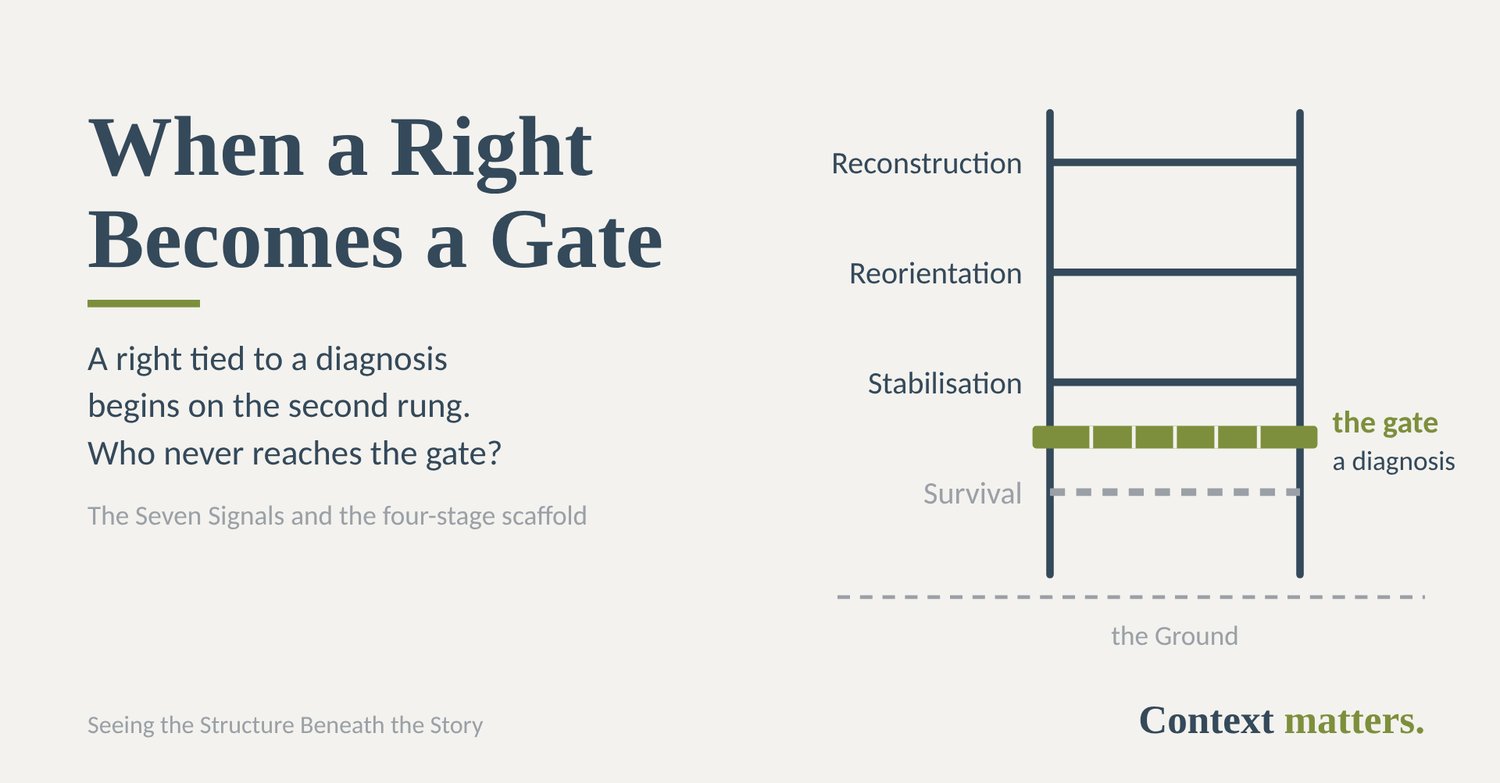
The Seven Signals and the four-stage scaffold applied to the Right to Addiction Recovery (Scotland) Bill
Standpoint
I write from practice. For much of my career in the National Health Service in Scotland, the work that mattered most began with people who would only come near a service if they could do so without giving their name. The needle exchange, the outreach contact and the peer educator were the first rungs of everything that followed: testing, treatment, and sometimes, much later, recovery. Anyone who has worked on those rungs knows that anonymity is not an obstacle to care. It is often the condition for it.
The same is true of the records those services keep. They are deliberately thin. They show that someone was seen and helped, and very little else, and that is the reason people are willing to give them.
This piece does not argue against a right to treatment. People who want residential rehabilitation and cannot reach it are being failed, and the case for better access is real. It asks what a particular design would do to the people on the lowest rungs, who are rarely in the room when rights are written. Experience, mine included, is a starting point, not a verdict. The documents are the evidence, and the piece rests on them.
Method and independence
This piece draws only on public records: the Bill as introduced, its policy and financial memoranda, the parliamentary record, Scottish Government publications, procurement notices, Public Health Scotland reports, health board and council guidance, published charity accounts, and reporting of court decisions in Alberta. Each factual claim was checked against the primary document where one exists. Where only news reporting was available, as with the Alberta court decisions and the statements on Glasgow's safer drug consumption facility, the reporting itself is cited. Sources without a publication date are cited with the date they were accessed, 13 October 2026.
Organisations whose positions are discussed are named only in citations and references, and no individual is named in the body. The piece describes mechanisms, not motives. Figures produced by applying arithmetic to published numbers are labelled as illustrative in the text. Claims that could not be verified from a public source were left out. Any error of fact brought to the author's attention will be corrected, and the correction noted.
Context Matters Consultancy is independent: this work is not commissioned, and it receives no external funding. It is paid for from the author's own professional income. The author has no financial, contractual or advisory relationship with any organisation discussed, including providers of residential rehabilitation, advocacy services and those who promoted or assisted in drafting the Bill. The author worked in the National Health Service in Scotland until 2013 and holds no current post with any public body discussed. The author also runs EiE Training, which provides professional development courses; its income does not cover its costs, and most Context Matters Consultancy material is free.
Why a Bill that fell
The Right to Addiction Recovery (Scotland) Bill was introduced on 14 May 2024 and fell at Stage 1 on 9 October 2025, by 63 votes to 52 (Scottish Parliament, 2024). Analysing legislation that has completed its parliamentary life has two purposes. The first is method. The Seven Signals and the four-stage scaffold are tools for reading a system before its outcomes arrive, and a fallen Bill is a clean case: its text, its memoranda and its costings are fixed and public. The second is the future. An organisation that assisted in drafting the Bill has stated, in its annual report for 2025, that it intends to work with partners to return the Bill to Parliament (Faces & Voices of Recovery UK, 2025). On 29/10/2026, the Scottish Parliament agreed that “the right to recovery must be considered as part of the efforts to address substance abuse” (Scottish Parliament, 2026). Any new Bill will draw on the same design. Reading the design now means the analysis exists before the debate does.
The Bill never operated, so this piece renders no verdict on outcomes. It reads a design against the conditions it would have met, and against one place where a similar lever was pulled.
Movement One: The design in full
Theorist: Thomas Szasz, on diagnosis as status
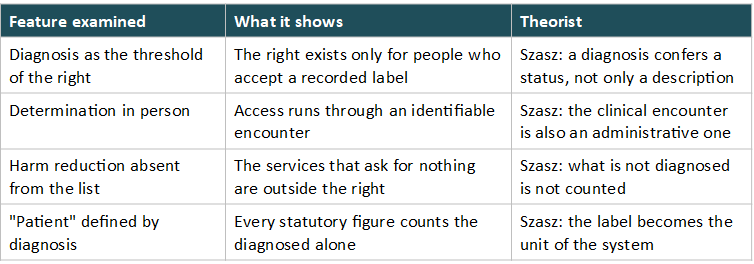
The Bill's central provision was simple. Section 1 gave every person diagnosed as having a drug or alcohol addiction the right to receive a treatment determination and to be provided with the treatment determined. A person counted as diagnosed when a relevant health professional had diagnosed an illness involving addiction to, or dependency on, a drug or alcohol (Right to Addiction Recovery (Scotland) Bill, 2024, s. 1). A relevant health professional meant a medical practitioner, a nurse independent prescriber or a pharmacist independent prescriber (s. 9).
The procedure followed from the diagnosis. The determination had to follow a meeting in person between the professional and the patient (s. 2(1)(d)). The patient could request any listed treatment, and a refusal had to be explained in writing, with a right to a second opinion (s. 2(2) to (4)). Treatment had to be available within three weeks of the determination (s. 3(1)). It could not be refused on any ground other than the professional's assessment of the patient's best interests, and the Bill listed grounds that could not be used, beginning with the cost of the treatment and including a criminal record, ongoing substance use and an existing prescription for opioid replacement (s. 3(2)). Scottish Ministers were placed under a duty to secure delivery of the rights (s. 4), to report annually to Parliament by health board area (s. 5), and to issue a code of practice with which health boards, local authorities and integration joint boards had to comply (s. 6). In the Bill, a "patient" meant a person who had received a diagnosis under section 1(2) (s. 9).
The policy memorandum removed any doubt about the threshold. The process was predicated on a diagnosis, and the right could not be accessed without one; self-diagnosis was excluded (Non-Government Bills Unit, 2024a, para. 46). The memorandum expected that the right would be enforced through National Health Service complaints procedures and, failing that, by judicial review in the Court of Session (para. 51).
The statutory list of treatments named residential rehabilitation, community-based rehabilitation, residential detoxification, community-based detoxification, stabilisation services and substitute prescribing services, together with any other treatment the professional deemed appropriate, and Ministers could add further treatments by regulation (s. 1(5) and (6)). The list is pluralist about treatment. Substitute prescribing is named, and the Bill barred refusing a person treatment because they were already receiving it (s. 3(2)(g) and (h)). It is silent on harm reduction. Injecting equipment provision, naloxone, drug checking and supervised consumption appear nowhere in it.
That silence sits awkwardly with how the Bill was presented. A statement published in 2023 by an organisation that assisted in drafting it described the Bill as covering all treatment options, with pathways running from drug consumption rooms to rehabilitation (Taking Action on Addiction, 2023). The Bill as introduced the following year did not name consumption rooms, or any other low-threshold service.
Szasz argued that a diagnosis is not only a clinical description but a conferral of status, with consequences that reach well beyond the clinic (Szasz, 1961). In this design the diagnosis does exactly that. It is the condition of the right, the definition of the patient, and the unit of every statistic the Bill would produce.
Movement Two: The conditions the design would meet
Theorist: Michel Foucault, on space and the register
Harm reduction in Scotland works under conditions that the Bill did not describe.
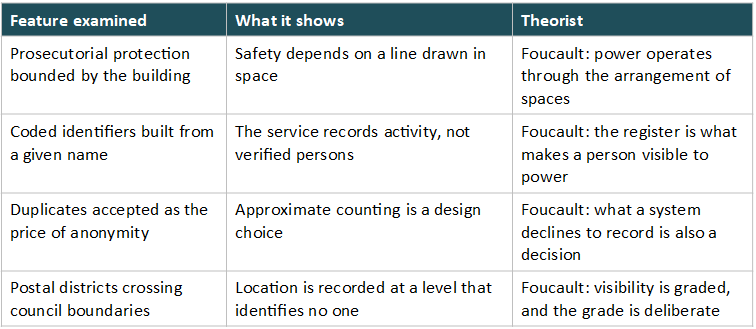
The first is legal. Possession of a controlled drug remains a criminal offence under section 5(2) of the Misuse of Drugs Act 1971, and drug law is reserved to Westminster. The Thistle, Glasgow's safer drug consumption facility, opened on 13 January 2025 because the Lord Advocate issued a statement of prosecution policy that it would not be in the public interest to prosecute users for simple possession inside the facility (Pharmaceutical Journal, 2025). That protection is bounded by the building. It does not extend to people on their way to or from the facility, and drugs seized by police are not returned (PA Media, 2025). The United Kingdom Government has said it has no plans to amend the Misuse of Drugs Act to allow further facilities (Drink and Drugs News, 2025). Holyrood can fund and design the service. It cannot change the criminal law around the people who use it.
The second condition is how identity is recorded. Public Health Scotland's statistics on injecting equipment provision are drawn from Needle Exchange Online, the database health boards use to record that activity, with island boards using paper surveys (Public Health Scotland, n.d.). Current service level guidance requires transactions to be recorded with a client identifier that is anonymous and unique, made from the first initial of the forename, the first and fourth letters of the surname, and the date of birth (NHS Grampian, 2025). Guidance in Fife sets out the same format with gender, and states that a client who wishes to remain anonymous can be recorded as anonymous (NHS Fife, 2025). No Community Health Index number is recorded. In practice the name the code is built from is whatever name the person gives, assumed or real.
The identifier is unverified by design. A needs assessment of people injecting in public places in Glasgow, drawing on the same database, noted that some individuals may have registered more than once, and used repeat transactions as a proxy for unique users (Tweed et al., 2018). A person can use an outlet in one town one week and another the next, giving a different name, and each record is valid. The system counts transactions reliably and people only approximately. That is the price of anonymity, and public health has paid it deliberately.
The location field is equally coarse. The reporting form records a postal district (NHS Fife, 2025). A postal district is a mail delivery unit, not an administrative area. G74 carries a Glasgow postcode but covers the north of East Kilbride and Thorntonhall, wholly within South Lanarkshire; the neighbouring G76 spans Busby, Carmunnock, Clarkston, Eaglesham and Waterfoot, across East Renfrewshire, Glasgow City and small parts of South Lanarkshire (Office for National Statistics, n.d.). A record reading G76 places a person somewhere across three council areas.
Foucault described how institutions govern through the arrangement of spaces and through the register: the record that makes an individual visible, comparable and available to authority (Foucault, 1977). Harm reduction in Scotland has been built to stay outside the register. Its protection is spatial, its records are pseudonymous, and its geography is deliberately blurred. Those are not gaps in the system. They are the system.
Movement Three: The conversion route
Theorist: Erving Goffman, on stigma and the record
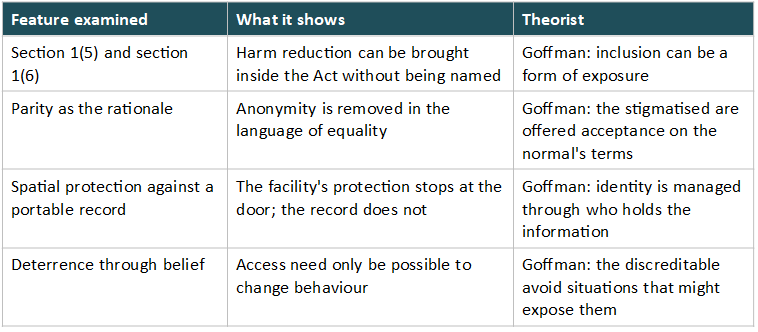
The Bill did not need to name harm reduction to reach it. Section 1(5) defined treatment as including, but not limited to, the listed services, and admitted any other treatment a relevant health professional deemed appropriate. Section 1(6) allowed Ministers to add treatments by regulation. Once injecting equipment provision, or a consumption service, is recognised as a treatment under the Act, accessing it as a right brings the Act's procedure with it: a diagnosis by a relevant health professional, a determination made at an in-person meeting, and a person who is now a patient within the meaning of section 9. A patient in the National Health Service in Scotland is identified by name, date of birth and Community Health Index number, which links them across every record the service holds.
The move would be framed as parity. People who use harm reduction services would finally be treated like every other patient, with a named professional who knows them. Nothing would be cut. What would be removed is the self-declared, unlinkable identity on which the service depends, and it would be removed in the language of equality.
The protection described in Movement Two is spatial. A named record is not. The prosecutorial policy still stops at the door of the facility, but a record holding a verified identity now exists outside it, inside the health service's systems. That changes what a police inquiry can ask for. Police Scotland has no automatic right of access to health records, except in matters of child protection; access is sought through a letter of authority from the Procurator Fiscal, a sheriff warrant, or a request under Schedule 2, Part 1, paragraph 2 of the Data Protection Act 2018 (NHS Lothian, 2023). A Schedule 2 request gives no automatic right of access; the body holding the data assesses each request and decides whether to disclose (Newcastle-under-Lyme Borough Council, n.d.), and professional guidance asks clinicians to weigh the seriousness of the crime and the reasons for the request (Scottish Dental Clinical Effectiveness Programme, n.d.). Disclosure for simple possession alone would be hard to justify. An investigation into a more serious offence in the area around a facility is another matter. Where the records hold a code built from a given name, there is nothing worth seeking. Where they hold a verified identity, police could seek them.
The policy memorandum anticipated some of this. It stated that data for the annual report would be handled as special category data, published anonymised, and not used to intervene in individual cases (Non-Government Bills Unit, 2024a, para. 44). That protects the published statistics. It says nothing about the clinical record from which they are drawn.
Deterrence does not depend on how often access happens. It depends on whether a person believes the record exists and could be reached. The people most likely to stay away are those with the most reason to distrust services, who are the people harm reduction exists to reach. A recorded diagnosis of addiction also carries consequences outside criminal law, in child protection, housing, employment and insurance, which is why many people keep their distance from the register in the first place.
Goffman described stigma as a spoiled identity managed through control of information: what is disclosed, to whom, and on what record (Goffman, 1963). Harm reduction lets people manage that information themselves.
A diagnosis gate takes the management out of their hands at the point of entry, and fixes the identity in a record they do not control.
Movement Four: The money
Theorist: Pierre Bourdieu, on the field and its stakes
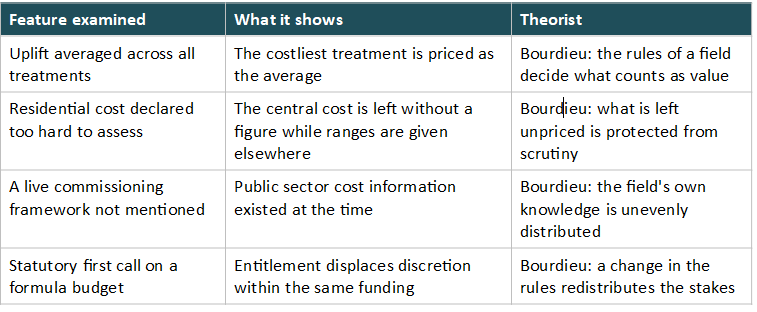
The financial memorandum used £160 million as the alcohol and drugs budget for 2024 to 2025 (Non-Government Bills Unit, 2024b, para. 22). It estimated the cost of treatment under the Bill at between £188.5 million and £198 million, an increase of between £28.5 million and £38 million a year (para. 61). It reached that figure by scaling the whole budget in proportion to the additional treatments it expected to be completed, which treats every treatment as costing the same on average.
For the one treatment the Bill was built around, it did not attempt a figure. It cited the Scottish Government's 2021 provider survey, which found an average placement cost in residential rehabilitation of £18,112, ranging from £6,504 to £27,500, with private placements typically shorter and more expensive and third sector placements longer and cheaper (para. 38). It then concluded that the variation in placement length and provider type made it challenging to assess the increase in cost under the Bill for residential rehabilitation specifically, and that up to date weekly costs by sector did not appear to be available (para. 41). Elsewhere in the same document, every uncertain cost was given a low and a high estimate.
Three sources on residential costs existed when the memorandum was published. The first was the 2021 survey it quoted. The second was Public Health Scotland's monitoring of statutory funded placements, which reported that 1,119 placements approved between 1 April 2021 and 31 December 2022 had a total estimated cost of £8,624,861 (Public Health Scotland, 2023). The third was a national commissioning framework. Scotland Excel published the tender for a National Flexible Framework Agreement for residential rehabilitation on 3 November 2023, with a deadline of 12 January 2024; the framework was awarded in March 2024 and commenced on 1 April 2024, and the award notice was published on 26 April 2024, recording 11 tenders and a maximum estimated value of £60 million (Scotland Excel, 2024a, 2024b, 2024c; Supplier Development Programme, 2023). The Scottish Government described the framework as the product of two years of market analysis and stakeholder engagement, and told Alcohol and Drug Partnerships it expected them to use it (Scottish Government, 2025b). The memorandum was published on 14 May 2024, six weeks after the framework went live, and does not mention it.
The memorandum's own figures can be set against each other. It assumed 650 publicly funded residential beds, each supporting two to three patients a year (para. 63). At its own average placement cost of £18,112, 1,300 placements would cost about £23.5 million and 1,950 placements about £35.3 million: between 15 and 22 per cent of the £160 million budget. That is illustrative arithmetic on the memorandum's numbers, not an estimate of actual spending. It shows that the residential element alone, at the Government's own target, would cost roughly as much as the whole uplift the memorandum calculated for every treatment.
The framework defines the service it buys. Its tender states that residential rehabilitation programmes aim to support individuals to attain a lifestyle free of alcohol and drugs and to be reintegrated into society (Scotland Excel, 2024a). The Bill named substitute prescribing alongside residential rehabilitation. The residential route it would have funded is defined, at the point of purchase, by abstinence.
How money reaches the services matters as much as the total. Core funding for Alcohol and Drug Partnerships is allocated by the National Health Service Scotland Resource Allocation Committee formula, which is based on population and need, not on reported patient numbers; some specific programme funding, including for medication assisted treatment, has been allocated on other bases (Scottish Government, 2025a). The memorandum itself states that the treatment services coordinated by the partnerships include harm reduction services (para. 42). So the statutory right and the low-threshold services would have drawn on the same partnership budgets. A right that cannot be refused on cost, with a ministerial duty and judicial review behind it, takes first call on a budget set by formula. Services without a statutory duty absorb whatever is left.
Bourdieu described a field as a space of positions in which actors compete for the resources that the field's own rules make valuable (Bourdieu and Wacquant, 1992). A statutory right changes the rules. It turns one category of provision into an entitlement, and every other category into a discretionary cost.
Movement Five: The advocate
Theorist: Jürgen Habermas, on system and lifeworld
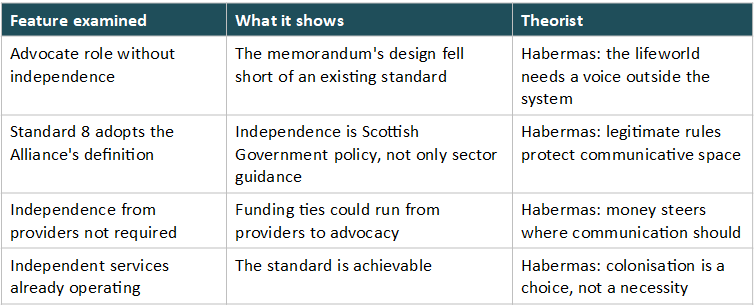
The policy memorandum anticipated that the code of practice would encourage people to bring a person with lived or living experience to the discussion of treatment options, and that patients should be given the means to easily access an advocate (Non-Government Bills Unit, 2024a, para. 41). It did not say that the advocate should be independent.
Scotland already had a standard that required independence. Medication Assisted Treatment Standard 8, published in 2021, states that all people should have access to independent advocacy and support for housing, welfare and income needs. It adopts the Scottish Independent Advocacy Alliance's definition of independent advocacy, and states that independence means an advocacy organisation provides no service other than independent advocacy (Scottish Government, 2021). Healthcare Improvement Scotland has since worked with the Alliance to develop resources that embed independent advocacy in the structures of alcohol and drug services (Healthcare Improvement Scotland, n.d.).
The Alliance's standards are explicit. An independent advocacy organisation provides no other services and has no other interests, ties or links beyond the delivery, promotion, support and defence of independent advocacy (Scottish Independent Advocacy Alliance, 2019). It is structurally, financially and psychologically free from interests such as being a provider of services, a gatekeeper of services or a funder of services (Scottish Independent Advocacy Alliance, n.d.). Its 2026 manifesto adds that funding arrangements must not create conflicts of interest (Scottish Independent Advocacy Alliance, 2026a), and its 2026 guidance for alcohol and drug services repeats that independent advocacy organisations must be structurally, financially and psychologically independent from service providers and statutory organisations (Scottish Independent Advocacy Alliance, 2026b). Independent advocacy works with the person's own views, not with an assessment of their best interests.
The memorandum was published three years after Standard 8. Its advocate role was left unspecified against a Government standard that already required independence. That gap matters. An organisation that campaigns for one category of provision, runs other services, or draws funding from providers of that provision would not meet Scotland's own definition of independent advocacy, however good its casework, and the design gave no assurance that the advocate attached to the right would be anything else. Genuinely independent alcohol and drug advocacy already exists in Scotland, commissioned locally and operating within the Alliance's standards (Glasgow City Health and Social Care Partnership, n.d.; Partners in Advocacy, n.d.). The standard can be met. The Bill's design simply did not require it.
None of this is a finding about any person's intentions. It is a measurement of a design against a published standard. Habermas described the colonisation of the lifeworld, where the logic of systems, money and administrative power, enters spaces that should run on people's own understanding of their lives (Habermas, 1987). Independent advocacy exists to hold that line for the person. An advocate whose organisation has a stake in the outcome stands on the system's side of it, however close they stand to the person.
Movement Six: The precedents
Theorist: Robert K. Merton, on the self-fulfilling prophecy
The lever this design would have created has been pulled before, once in Britain and once in Alberta.
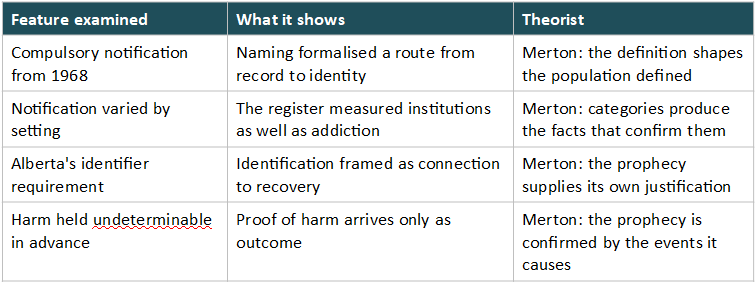
Before 1968, doctors in Britain were not required to notify the Home Office of patients who were addicted; the Home Office learned about prescribing largely through routine police examination of pharmacists' records (United Nations Office on Drugs and Crime, 1966). The Dangerous Drugs Act 1967 introduced compulsory notification. A Home Office study of men first notified as addicts in 1969 followed two samples for five years. Of those notified by hospitals, 95 per cent were judged addicted to opiates at some point during follow up; of those notified by penal establishments, 30 per cent. The authors concluded that notification depended as much on the setting in which doctors saw their patients as on clinical judgement (Mott and Macmillan, 1979). A named register reflects the institution doing the naming as much as the population named.
In Alberta, new mandatory standards for supervised consumption sites required staff, from 1 February 2022, to ask clients for their personal health number. The same standards required referrals to addiction treatment and recovery services, and agreements with nearby businesses and residents (CBC News, 2022a). A ministry official stated in an affidavit that asking for the number would help providers transition people into recovery-focused supports, and under cross-examination said that clients would not be refused if they did not have a number or declined to obtain one (CTV News, 2022). One client told the court he had never been asked for his name or number, and would stop attending if he were (CBC News, 2022b). Two harm reduction organisations sought an injunction. It was refused at first instance and by the Court of Appeal, and the Supreme Court of Canada declined to hear the case. The Alberta courts accepted that deaths might occur as clients avoided the sites, but held that the extent of the harm could not be determined in advance, so the threshold for an injunction was not met (CBC News, 2022c).
That reasoning is the trap in its clearest form. The harm of an identification requirement cannot be proven until it has happened, and the only proof is the outcome itself. Every safeguard that waits for evidence of harm waits for casualties.
The minister reported that average daily unique clients at a Calgary site rose by 12 per cent in the first month after the requirement began (CBC News, 2022c). Before identification, unique clients could only be estimated; after it, they could be counted. A rise in counted unique clients immediately after an identifier is introduced may reflect the change in measurement as much as any change in attendance. The 1969 notification study shows how much a register's figures depend on how the register is built.
Merton described the self-fulfilling prophecy as a false definition of a situation that evokes new behaviour which makes the original false conception come true, and then cites the actual course of events as proof that it was right from the beginning (Merton, 1948). A design that predicts harm reduction will fail, then removes the anonymity on which it depends and counts only the people who remain, will be able to point to the result.
Movement Seven: The Seven Signals applied
Framework: Context Matters Consultancy, the Seven Signals and the four reversal conditions
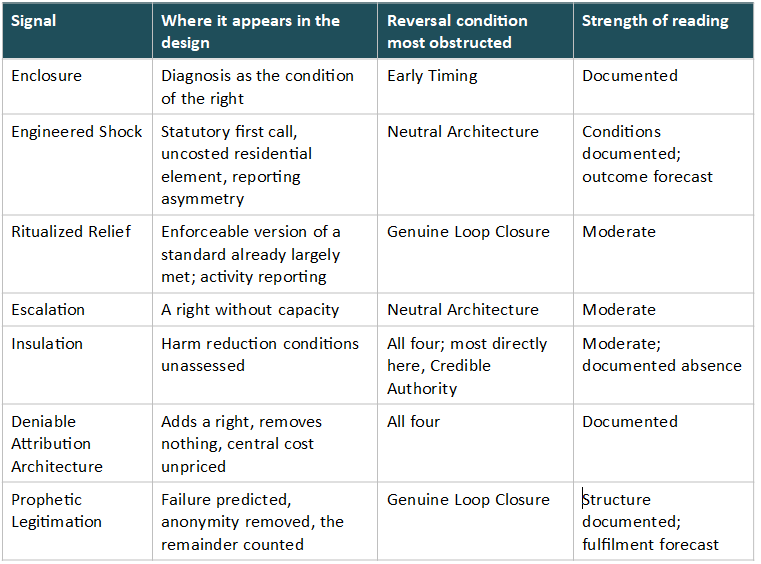
The Seven Signals were introduced in "Maps, Not Mandates" (Storrar, 2026a), with each to be set out in full in later pieces. They read a person or an institution before the outcome arrives. The four reversal conditions are Early Timing, Credible Authority, Genuine Loop Closure and Neutral Architecture. Each signal below is read from the Bill's own documents, with the strength of the reading stated. No phase is assigned, because the Bill never operated.
Enclosure is the fence that builds as a crisis builds and works in both directions.
Here it is the diagnosis gate: a label for service access, written into law, and built by bringing people inside it. Documented.
Engineered Shock manufactures a crisis that makes a predetermined outcome look like necessity, and the service hit need not be the target. Here it is the statutory first call on a formula budget, the uncosted central treatment, and a reporting duty under which low-threshold services produce no statutory figures, so that their apparent failure would justify their reduction. The conditions are documented; the outcome is a forecast.
Ritualized Relief lets pressure escape through ritual rather than change; in institutions it is reporting that counts activity. The three-week standard the Bill would have made enforceable was already met for 92.3 per cent of referrals in the quarter the policy memorandum cited (Non-Government Bills Unit, 2024a, para. 9), and its annual report would have counted determinations, waits and second opinions rather than survival and recovery. Moderate.
Escalation, in a service, is innovation that does not improve what is delivered. The Bill turned a standard into a right without creating capacity, and the memorandum acknowledged that delivery would be extremely challenging for some treatments (para. 10). A deadline without beds produces a queue with legal standing. Moderate.
Insulation is life behind the fence, ambivalent to causes it does not see. The memorandum stated that routes to treatment not involving a diagnosis would be unaffected (para. 47), and did not assess the coded identifiers, the spatial protection or the reserved criminal law on which those routes depend. Moderate, resting on a documented absence
Deniable Attribution Architecture is the set of mechanisms by which no one can be said to have caused an outcome. The Bill adds a right and removes nothing, leaves its central cost unpriced, and protects published statistics while saying nothing of the clinical record. If attendance at harm reduction services fell, every actor could truthfully say they never intended it. Documented.
Prophetic Legitimation is the prophecy spoken at the start and fulfilled at the end, and it legitimises the other six. Harm reduction is sometimes described in public advocacy as maintenance that keeps people alive without helping them live; the design counts only the diagnosed; the services that cannot produce diagnosed patients then appear to deliver nothing. Alberta's courts held that the extent of such harm could not be established in advance. The structure is documented; the fulfilment would be the outcome.
Movement Eight: What would work
Framework: the four-stage scaffold and the reversal conditions, read as design principles
Critique is easier than design, and a reading that only says what would go wrong leaves the field to those willing to propose something. What follows is not a model to be imposed. No one has the right to decide another person's route through recovery. It is a set of design principles that follow from the signals and the scaffold, and each has been checked against what Scotland already has, so that existing policy is credited rather than claimed.
That check matters, because a great deal already exists. On 10 March 2026 the Scottish Government published a strategic plan for alcohol and drugs to 2035, a national specification for alcohol and drug services, and a revised Partnership Delivery Framework (Scottish Government, 2026a, 2026b, 2026c). The specification is not statutory, but it sets minimum expectations for local systems, with national standards to assess implementation scheduled for 2027/28. It lists harm reduction, including advice, equipment, naloxone, drug checking and safer consumption where available; residential rehabilitation alongside detoxification and medication assisted treatment; defined pathways between custody and community; seamless transitions from detoxification through rehabilitation to aftercare; independent advocacy; and housing, employment and income support (Scottish Government, 2026b).
The Medication Assisted Treatment standards already provide for same-day access, choice of treatment and independent advocacy (Scottish Government, 2021). The Charter of Rights for People Affected by Substance Use, published in December 2024, describes people as rights-holders and services as duty bearers, built on dignity, respect, choice, participation and accountability, though it is guidance rather than law (Scottish Government, n.d.). The framework sets out lines of accountability for each public body and requires commissioned services to report measured outcomes and spend (Scottish Government, 2026c).
Support at work is also further along than the debate suggests. The National Health Service Scotland workforce policy on alcohol and other substances, published on 1 October 2025, supports all National Health Service staff to seek help and to disclose in confidence (NHS Scotland, 2025), and council policies go further in places: one provides that disciplinary or other processes may be paused or stopped where a colleague seeks treatment, and that such matters are handled in confidence (City of Edinburgh Council, 2023), and another treats disclosure as a mitigating factor in discipline (The Highland Council, 2025).
Much of the scaffold, in other words, is already written down as guidance.
What none of these documents does is protect the lowest rungs. The specification, the strategic plan and the framework are silent on anonymous access to services and on identification; the framework's only reference to anonymity concerns feedback from people with lived experience. The framework does protect national alcohol and drug funding: it should not be subject to efficiency or wider savings targets, or redirection (Scottish Government, 2026c). Nothing protects harm reduction's share within that funding. None measures whether people move between stages. None addresses conflicts of interest among the organisations that shape or deliver services. The design principles below are written with that distinction kept visible.
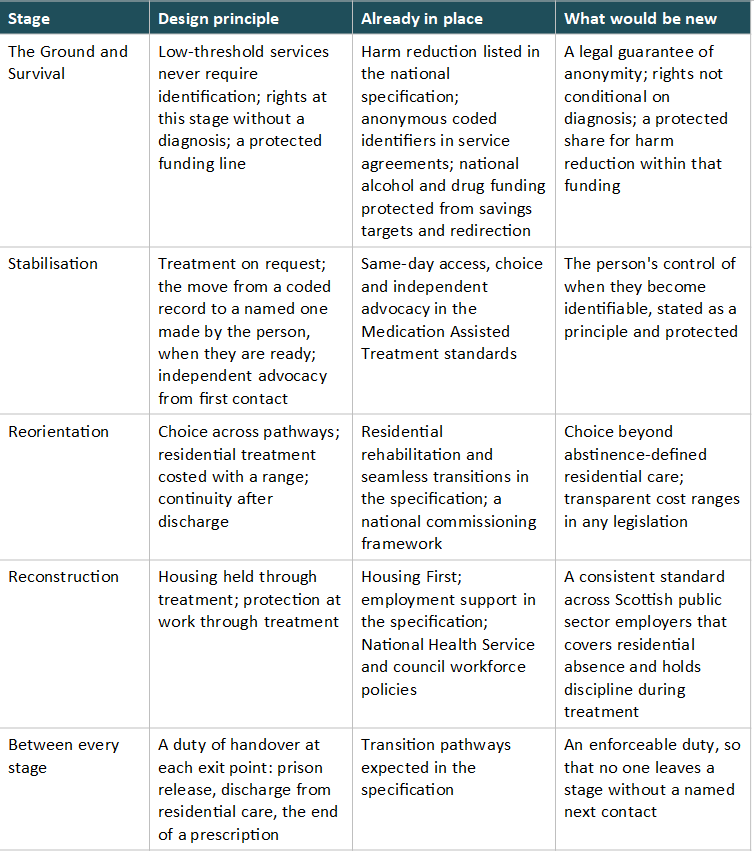
Three further principles run across the whole scaffold.
The first is measurement. The strategic plan makes the national drug and alcohol information system the primary tool for monitoring treatment, and residential rehabilitation already collects client-level outcomes (Scottish Government, 2026a). Neither measures movement. A working design would count contacts and overdoses reversed at Survival, anonymised; retention and blood borne virus testing and treatment at Stabilisation; starts, completions and choices honoured at Reorientation; tenancies, work and education at Reconstruction; and deaths, and movement between stages, across all of them. Until progression is measured, every part of the system can claim success at its own stage.
The second is accountability by lever. The Partnership Delivery Framework sets out who each public body answers to, but Alcohol and Drug Partnerships, which it describes as not a legal entity, have no dedicated line of accountability in its annex, and the reserved levers held at Westminster, drug law, employment and equality, are not mapped at all (Scottish Government, 2026c). A working design names each tier for the levers it holds, including the ones it does not.
The third is transparency of interests. The framework's planning, reporting and scrutiny section sets expectations of openness for statutory and commissioned providers, but does not address conflicts of interest (Scottish Government, 2026c). Any organisation that helps draft a right, or delivers services or advocacy under it, should publish its funding sources and declare any interest in the provision it would affect.
Each signal has a design answer, and each answer protects a reversal condition.
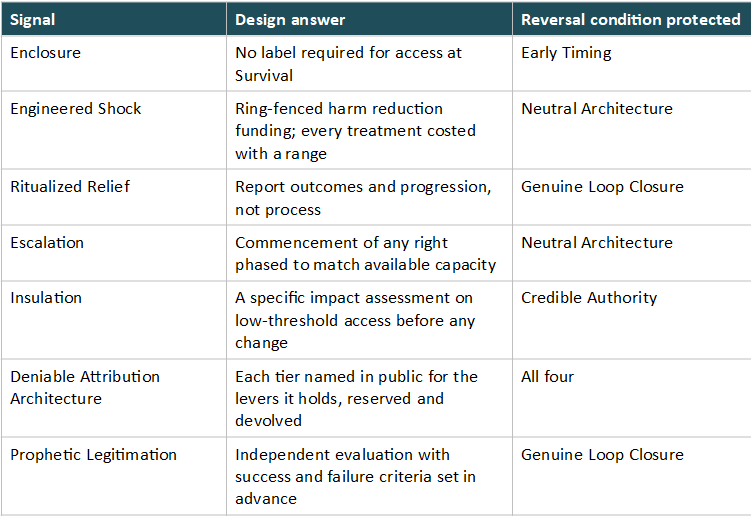
There are two places where these principles could be tested. The first is any new Bill. The second will happen whether or not a Bill returns: the national standards scheduled for 2027/28, which will decide how the specification is assessed. Anonymity at the lowest rung, a measure of progression and protected harm reduction funding can be argued for in either.
Synthesis: The scaffold and the Ground
Theorists: Abraham Maslow, on the hierarchy of needs; Lev Vygotsky, on the zone of proximal development; David Wood, Jerome Bruner and Gail Ross, on scaffolding
The scaffold shows why those principles matter, and what the Bill would have done without them. Context Matters Consultancy works with a four-stage scaffold: Survival, Stabilisation, Reorientation and Reconstruction. Beneath it lies the Ground: the soft, waterlogged ground on which a person stands before any help reaches them, which usually leads back to firmer footing and sometimes leads deeper.
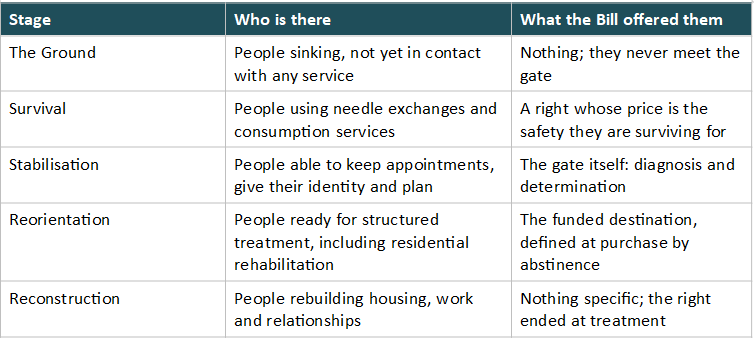
Survival is the decisive row. In Maslow's account, safety is among the most pressing needs, and lower needs take priority without having to be fully met first (Maslow, 1943). For a person in Survival, identification under criminal law is a direct threat to safety. Declining to be diagnosed is not non-compliance. It is the correct decision for someone at that stage, and the design would record it as low uptake. That is stabilisation misread as deterioration, at the point of entry.
Vygotsky located learning in the space between what a person can do alone and what they can do with support (Vygotsky, 1978). Wood, Bruner and Ross called the support scaffolding: calibrated to where the person is, temporary, and withdrawn as they can bear their own weight (Wood et al., 1976). Harm reduction is the scaffold that reaches onto the Ground. It meets people where they stand and asks nothing that would make them step back. A diagnosis gate begins help at Stabilisation, where the person can already stand. The people still sinking fall out of the service and out of the data at the same moment.
The same moment can be read through the perfect grey: the calm balance between dark and light, like an overcast sky, that the practitioner tries to guide a person towards. A person arriving at a needle exchange is rarely there. They arrive in a flash of light or a dark coldness: relief, fear, bravado, shame. In practice the practitioner notices the flash, asks about it, and gives the person the choice of whether to answer. If they choose not to, the practitioner relies on observation and keeps the door open. That choice not to tell is part of the method, not a failure of it. Anonymity gives it a structure: a person can be seen, helped and come back without saying who they are. A diagnosis gate removes the choice at the very moment a person is least able to make it well. The perfect grey is the firm ground at the end of the walk. It cannot be demanded at the door as the price of a hand.
The test for a new Bill
A forensic reading should say what would show it to be wrong. Movement Eight sets out the design; five of its principles form a simple test that any new or reworked Bill can be read against. Does it place low-threshold harm reduction outside any identification requirement? Does its reporting count contacts alongside patients, so that anonymous services produce statutory figures? Does it require any advocate attached to the right to meet Medication Assisted Treatment Standard 8? Does its financial memorandum cost residential rehabilitation with a range, using the national framework and Public Health Scotland's placement data? Does it protect harm reduction funding from being drawn down to meet the statutory duty?
A Bill that meets all five will have answered this piece. A Bill that meets none confirms it.
Conclusion
The Right to Addiction Recovery (Scotland) Bill was written to answer a real failure. People who want residential rehabilitation, and cannot reach it, are being failed, and the anger about that is justified. Its design, though, made a diagnosis the condition of the right, left out every service that asks for nothing, counted only the diagnosed, priced its central treatment as an average and declined to price it at all, and left its advocate role short of the independence Scotland already requires.
Each of those choices can be defended on its own. Together they describe a system that would have strengthened the upper rungs of the scaffold by loosening the lowest ones, and that would have produced statistics showing the lowest rungs had never held anyone.
The Bill fell. The design has not gone away, an organisation involved in drafting it has said it will return, and on 29/10/2026 the Scottish Parliament agreed that a right to recovery must be considered. When it does, the question is not whether people should have a right to treatment. It is whether the right will be built so that the people on the Ground can still reach the first rung without giving up the only protection they have.
Scotland already has most of the scaffold in writing. What it lacks is protection for the lowest rung, a measure of whether people climb, and openness about who has an interest in the climb. A right built on those three would be harder to oppose than the Bill that fell, because it would be a better version of the same promise.
What to watch
- Any draft proposal for a member's bill on a right to addiction recovery lodged in the current session of the Scottish Parliament, and whether it comes with a consultation or a statement of reasons. A draft proposal must be lodged before a Bill can be introduced, and a statement of reasons, if accepted by a committee, means there is no public consultation.
- The text of any such proposal, read against the five tests and the design principles above.
- The development of the national standards for alcohol and drug services, scheduled for 2027/28, and whether they address anonymity, progression and the protection of harm reduction funding.
- The interim review of the Partnership Delivery Framework in spring 2028.
- The evaluation of the Thistle, and whether its reporting distinguishes counted individuals from contacts.
- The Scotland Excel residential rehabilitation framework, whose initial period ran to 31 March 2026 with options to extend to 31 March 2028, and any published rate information.
- Alberta's continuing data on attendance and deaths at the sites that remain, read against changes in its drug supply.
Two companion pieces follow this one. What Gets Counted Gets Funded sets out what Scotland's residential rehabilitation figures show in 2026 (Storrar, 2026b). Before the Bill, to be published in November 2026, reads what a reworked right might ask of the system before any proposal is lodged, and draws the tests in this piece and its companion into six (Storrar, 2026c).
References
Bourdieu, P., & Wacquant, L. J. D. (1992). An invitation to reflexive sociology. University of Chicago Press.
CBC News. (2022a, January). Alberta court says supervised consumption sites can ask for health ID numbers. https://www.cbc.ca/news/canada/edmonton/alberta-court-says-supervised-consumption-sites-can-ask-for-health-id-numbers-1.6311502
CBC News. (2022b, January). Alberta top court reserves decision on supervised consumption site injunction. https://www.cbc.ca/1.6330584
CBC News. (2022c). Supreme Court dismisses bid for injunction on Alberta supervised consumption site policy. https://www.cbc.ca/1.6412434
City of Edinburgh Council. (2023). Alcohol and drugs policy [Report to Policy and Sustainability Committee, 23 May 2023]. https://democracy.edinburgh.gov.uk/documents/s57485/Item%207.11%20-%20Alcohol%20and%20Drugs%20Policy.pdf
CTV News. (2022, January). Court to hear urgent appeal on Alberta ID policy for supervised drug-use sites. https://calgary.ctvnews.ca/court-to-hear-urgent-appeal-on-alberta-id-policy-for-supervised-drug-use-sites-1.5745986
Dangerous Drugs Act 1967, c. 82.
Data Protection Act 2018, c. 12, Schedule 2.
Drink and Drugs News. (2025). Government rules out changes to consumption room legislation. https://www.drinkanddrugsnews.com/government-rules-out-changes-to-consumption-room-legislation/
Faces & Voices of Recovery UK. (2025). FAVOR UK annual report 2025 [Annual report and accounts]. Office of the Scottish Charity Regulator. https://oscr-docs.s3.eu-west-2.amazonaws.com/favor-uk-annual-report-2025-small-0147GKMYOAGFT5OYKF7VDZQZVDUNQZYBHB.pdf
Foucault, M. (1977). Discipline and punish: The birth of the prison (A. Sheridan, Trans.). Pantheon Books.
Glasgow City Health and Social Care Partnership. (n.d.). New Glasgow alcohol and drugs advocacy service. Retrieved 13 October 2026, from https://glasgowcity.hscp.scot/index.php/node/1864
Goffman, E. (1963). Stigma: Notes on the management of spoiled identity. Prentice-Hall.
Habermas, J. (1987). The theory of communicative action: Vol. 2. Lifeworld and system: A critique of functionalist reason (T. McCarthy, Trans.). Beacon Press.
Healthcare Improvement Scotland. (n.d.). Understanding independent advocacy. Retrieved 13 October 2026, from https://www.healthcareimprovementscotland.scot/?p=29053
The Highland Council. (2025, September). Workplace drug and alcohol support policy. https://www.highland.gov.uk/peopleandperformance/download/downloads/id/915/workplace_drug_and_alcohol_support_policy.pdf
Maslow, A. H. (1943). A theory of human motivation. Psychological Review, 50(4), 370-396.
Merton, R. K. (1948). The self-fulfilling prophecy. The Antioch Review, 8(2), 193-210.
Misuse of Drugs Act 1971, c. 38.
Mott, J., & Macmillan, J. (1979). The validity of addict notifications. The British Journal of Psychiatry, 134(3), 264-268. https://doi.org/10.1192/bjp.134.3.264
Newcastle-under-Lyme Borough Council. (n.d.). Schedule 2 Part 1 (2) disclosure requests. Retrieved 13 October 2026, from https://www.newcastle-staffs.gov.uk/data-protection-freedom-information-1/schedule-2-part-1-2-disclosure-requests
NHS Fife. (2025, May 15). NEO injecting equipment provision step-by-step guide; NEO reporting form for injecting equipment provision and take-home naloxone. https://www.communitypharmacy.scot.nhs.uk/nhs-fife/wp-content/uploads/sites/6/NEO-IEP-guide-15-05-25.pdf
NHS Grampian. (2025). Service level agreement: Injecting equipment provision 2025/26. https://www.communitypharmacy.scot.nhs.uk/nhs-grampian/wp-content/uploads/sites/10/SLA_Injecting-Equipment-Provision_25.26.docx
NHS Lothian. (2023). Processing access requests procedure. https://policyonline.nhslothian.scot/wp-content/uploads/2023/03/Processing_Access_Requests_Procedure.pdf
NHS Scotland. (2025, October 1). Alcohol and other substances misuse policy [NHS Scotland workforce policy]. https://workforce.nhs.scot/policies/alcohol-and-other-substances-policy-overview/alcohol-and-other-substances-misuse-policy/
Non-Government Bills Unit. (2024a). Right to Addiction Recovery (Scotland) Bill: Policy memorandum (SP Bill 48-PM). Scottish Parliament. https://www.parliament.scot/-/media/files/legislation/bills/s6-bills/right-to-addiction-recovery-scotland-bill/introduced/policy-memorandum-accessible.pdf
Non-Government Bills Unit. (2024b). Right to Addiction Recovery (Scotland) Bill: Financial memorandum (SP Bill 48-FM). Scottish Parliament. https://www.parliament.scot/-/media/files/legislation/bills/s6-
bills/right-to-addiction-recovery-scotland-bill/introduced/financial-memorandum-accessible.pdf
Office for National Statistics. (n.d.). National statistics postcode lookup. Retrieved 13 October 2026, from https://geoportal.statistics.gov.uk/
PA Media. (2025). Lord Advocate says "no reason" to block more drug consumption rooms. https://www.yahoo.com/news/lord-advocate-says-no-reason-171818926.html
Partners in Advocacy. (n.d.). Highland Advocacy Partnership (alcohol and drugs) [Service listing]. ALISS. Retrieved 13 October 2026, from https://www.aliss.org/organisations/partners-in-advocacy
Pharmaceutical Journal. (2025). MPs launch inquiry as UK's first safe drug consumption facility opens. https://pharmaceutical-journal.com/article/news/mps-launch-inquiry-as-uks-first-safe-drug-consumption-facility-opens
Public Health Scotland. (2023, March 21). Interim monitoring report on statutory-funded residential rehabilitation placements: Placements approved by alcohol and drug partnerships between 1 April 2021 and 31 December 2022. https://www.publichealthscotland.scot/publications/interim-monitoring-report-on-statutory-funded-residential-rehabilitation-placements/
Public Health Scotland. (n.d.). Injecting equipment provision in Scotland. Retrieved 13 October 2026, from https://publichealthscotland.scot/our-areas-of-work/substance-use/data-and-intelligence/injecting-equipment-provision-in-scotland-iep
Right to Addiction Recovery (Scotland) Bill. (2024). SP Bill 48, Session 6, as introduced. Scottish Parliament. https://www.parliament.scot/-/media/files/legislation/bills/s6-bills/right-to-addiction-recovery-scotland-bill/introduced/bill-as-introduced.pdf
Scotland Excel. (2024a, April 26). Residential rehabilitation (alcohol and drugs) services national flexible framework agreement: Contract award notice (2024/S 000-013589). Find a Tender. https://www.find-tender.service.gov.uk/Notice/013589-2024
Scotland Excel. (2024b). Residential rehabilitation (alcohol and drugs) services [Contract directory]. Retrieved 13 October 2026, from https://home.scotland-excel.org.uk/our-contracts/contract-directory/residential-rehabilitation-alcohol-and-drugs-services/
Scotland Excel. (2024c). Annual procurement report: 1 April 2023 to 31 March 2024. https://home.scotland-excel.org.uk/media/rvtawumj/scotland-excel-annual-procurement-report-2024.pdf
Scottish Dental Clinical Effectiveness Programme. (n.d.). Disclosure of information to prevent serious crime or harm. Retrieved 13 October 2026, from https://psm.sdcep.org.uk/topics/ethical-practice/confidentiality-and-disclosure-of-information/disclosure-of-information-to-prevent-serious-crime-or-harm/
Scottish Government. (2021). Medication Assisted Treatment (MAT) standards: Access, choice, support. https://www.gov.scot/publications/medication-assisted-treatment-mat-standards-scotland-access-choice-support/pages/13/
Scottish Government. (2025a). Alcohol and drug services delivery support 2025-2026: Letter to alcohol and drug partnerships. https://www.gov.scot/publications/supporting-delivery-alcohol-drug-services-2025-26-funding-allocation-programme-government-funding-ministerial-priorities/
Scottish Government. (2025b, March 31). Alcohol and drug partnership letters 2024/25. https://www.gov.scot/publications/alcohol-drug-partnership-adp-letters-2024-25/
Scottish Government. (2026a, March 10). Preventing harm, promoting recovery: Scotland's alcohol and drugs strategic plan 2026-2035. https://www.gov.scot/publications/preventing-harm-promoting-recovery-scotlands-alcohol-drugs-strategic-plan-2026-2035/
Scottish Government. (2026b, March 10). Alcohol and drugs services: National specification. https://www.gov.scot/publications/national-specification-alcohol-drugs-services/
Scottish Government. (2026c, March 10). Alcohol and drugs: Partnership delivery framework 2026. https://www.gov.scot/publications/partnership-delivery-framework-alcohol-drugs-2026/
Scottish Government. (n.d.). Person-centred approaches: Charter of Rights for People Affected by Substance Use. Retrieved 13 October 2026, from https://www.gov.scot/policies/alcohol-and-drugs/person-centred-approaches/
Scottish Independent Advocacy Alliance. (2019). Independent advocacy principles, standards and code of best practice. https://www.siaa.org.uk/wp-content/uploads/2021/02/SIAA-Principles-Final-2nd-print-run-with-ISBN.pdf
Scottish Independent Advocacy Alliance. (2026a). Voice. Rights. Independence. 2026 manifesto for independent advocacy in Scotland. https://www.siaa.org.uk/wp-content/uploads/2026/02/Independent-Advocacy-2026-Manifesto-SIAA.pdf
Scottish Independent Advocacy Alliance. (2026b). The right to a voice: Independent advocacy in alcohol and drug services. https://www.siaa.org.uk/wp-content/uploads/2026/08/Strategic-Advocacy-Template-MAT-8-2-1.pdf
Scottish Independent Advocacy Alliance. (n.d.). Commonly used terms. Retrieved 13 October 2026, from https://www.siaa.org.uk/what-is-independent-advocacy/commonly-used-terms/
Scottish Parliament. (2024). Right to Addiction Recovery (Scotland) Bill [Bill page and Stage 1 record]. https://www.parliament.scot/bills-and-laws/bills/s6/right-to-addiction-recovery-scotland-bill
Scottish Parliament. (2026, 29 October). Official Report: Meeting of the Parliament, Alcohol and Drug Deaths (Public Health Approach) and Decision Time. https://www.parliament.scot/chamber-and-committees/official-report/search-what-was-said-in-parliament/meeting-of-parliament-29-10-2026?meeting=20306&iob=226536
Storrar, J. (2026a, 1 October). Maps, not mandates [Article]. LinkedIn.
Storrar, J. (2026b, 30 October). What gets counted gets funded [Blog article]. EiE Intelligence. https://www.linkedin.com/pulse/what-gets-counted-funded-jim-3lwce
Storrar, J. (2026c). Before the bill [Blog article, forthcoming November 2026]. EiE Intelligence.
Supplier Development Programme. (2023, November 9). Residential rehabilitation framework ITT launches. https://www.sdpscotland.co.uk/news/news/residential-rehabilitation-national-flexible-framework-itt-launches/
Szasz, T. S. (1961). The myth of mental illness: Foundations of a theory of personal conduct. Hoeber-Harper.
Taking Action on Addiction. (2023, May 8). Annemarie Ward, CEO of Faces and Voices of Recovery UK. https://takingactiononaddiction.org.uk/news/annemarie-ward-ceo-of-faces-and-voices-of-recovery-uk
Tweed, E., Rodgers, M., Priyadarshi, S., & Crighton, E. (2018). "Taking away the chaos": A health needs assessment for people who inject drugs in public places in Glasgow, Scotland. BMC Public Health, 18, Article 829. https://doi.org/10.1186/s12889-018-5718-9
United Nations Office on Drugs and Crime. (1966). Drug addiction in the United Kingdom. Bulletin on Narcotics. https://www.unodc.org/unodc/en/data-and-analysis/bulletin/bulletin_1966-01-01_2_page005.html
Vygotsky, L. S. (1978). Mind in society: The development of higher psychological processes. Harvard University Press.
Wood, D., Bruner, J. S., & Ross, G. (1976). The role of tutoring in problem solving. Journal of Child Psychology and Psychiatry, 17(2), 89-100.
About the author
Jim Storrar is the founder of Context Matters Consultancy and EiE Training, and a specialist in addiction, mental health and recovery. He began nursing in May 1987 and worked for twenty-six years in the National Health Service in Scotland, across psychiatric, addiction, forensic and public health settings. Between 2009 and 2013 he was Education and Prevention Specialist with NHS Ayrshire and Arran, where he was part of the team for Blood Borne Virus work under the national Hepatitis C target, developed the LearnPro Hepatitis C learning module, ran its peer education pilots, and delivered Alcohol Brief Interventions training. He later lectured in health and social care at West Lothian College. He holds a Bachelor of Science in Health Studies, a Diploma in Higher Education in Mental Health Nursing, a Postgraduate Diploma in Alcohol and Drug Studies and a Teaching Qualification in Further Education. He is a Specialist Member of the International Society of Substance Use Professionals and a member of the Association of Health Care Trainers.
Comments ()